


If you’ve been thinking about trying or migrating to Contentful CMS, there’s a lot you need to wrap your head around first. Like most modern CMS platforms, it promises flexibility and scalability.
Spoiler: It’s expensive when you scale, and you’re going to need a solid development team.
Before choosing Contentful, read through my guide below. It breaks down the top challenges to watch out for, the solutions you’ll need to fix them, and some alternatives to keep in mind.
Let’s take a look.
Highlights
Contentful CMS is a headless Content Management System that lets you create, manage, and deliver content across multiple platforms. In practice, it functions as a content distribution system, delivering structured data to websites, apps, and other digital touchpoints.
The Contentful platform uses an API-first architecture to separate content from presentation.
(Like websites, mobile apps, kiosks, and digital displays).
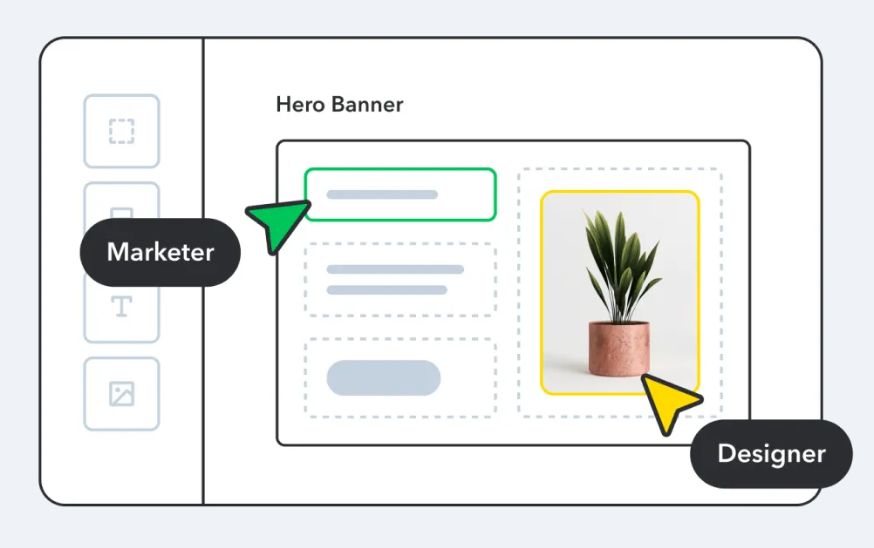
Unlike traditional CMSs, Contentful separates content from presentation by using APIs instead of a built-in front end. Hence the term “headless.” You model your content once, then developers pull it into any channel they need.
This makes it flexible and scalable. But it also means you’ll need technical setup and developer support to get the most out of it.
As far as pricing goes, Contentful has a free option, but it’s limited. Its broader suite of Contentful products includes additional enterprise features that increase cost as complexity grows. The next tier up is $300 a month, and the following tier shoots up to tens of thousands per month.
More on this below. 👇
Here’s what to watch out for if you’re considering using Contentful CMS, according to real users:
Contentful CMS has a modular system. This means you can update content in real time across every channel from a single change. That’s cool.
But if the content model and implementation aren’t done right, everything else becomes harder to manage at scale.
In the Reddit thread below, the original publisher is wondering what the difference between a “content type” and a “content model” is.
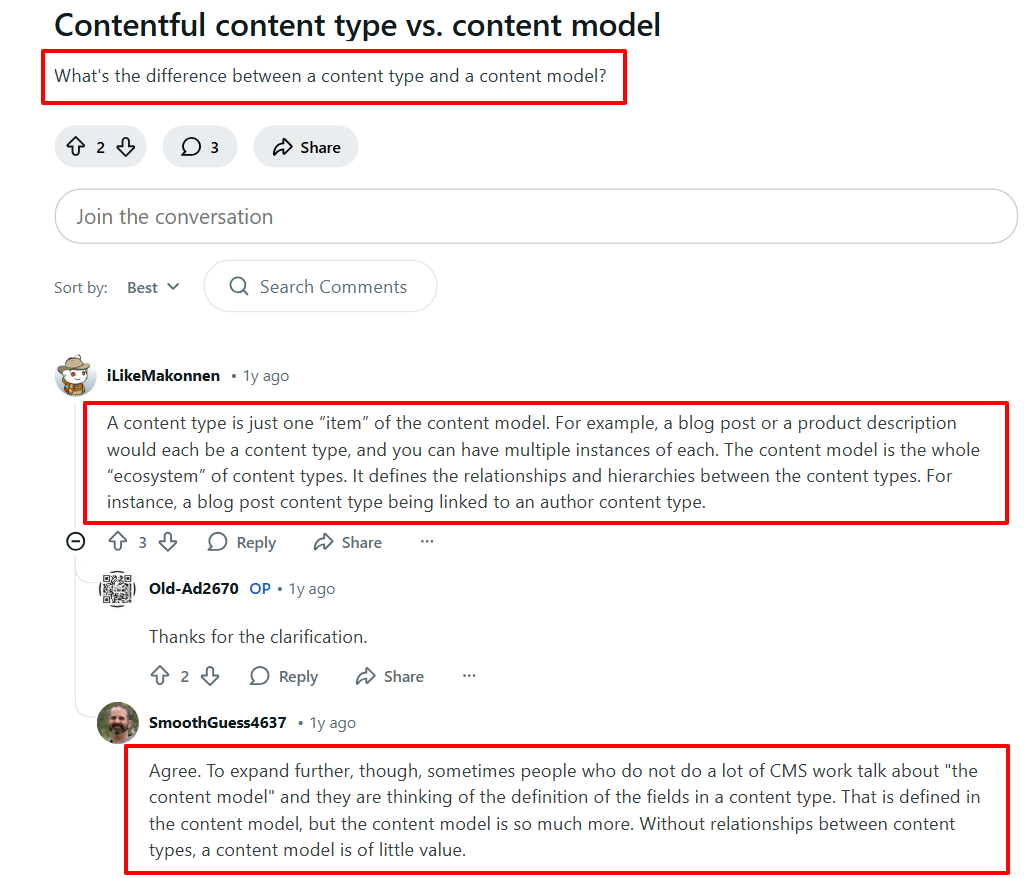
As you can tell by the responses, it gets pretty technical.
You definitely need to know what you’re doing. Otherwise, you have to worry about:
Content reuse breaks. Instead of updating once and publishing everywhere, you’ll end up maintaining multiple versions of the same content across digital channels. (Which totally defeats the point of using a headless CMS in the first place. 🙃)
Previews not matching production. You’ll have to spend more time reviewing, testing, and fixing content before it goes live if Live Preview isn’t accurate. What should’ve been a quick update now requires multiple checks.
Website performance issues surfacing downstream. Overfetching, inefficient queries, or bloated schemas can hurt your page speed and frontend performance. That directly impacts user experience, especially on high-traffic marketing sites. Yay for sluggish websites.
The fix:
Contentful’s pricing model can be a major pain point when you’re ready to scale.
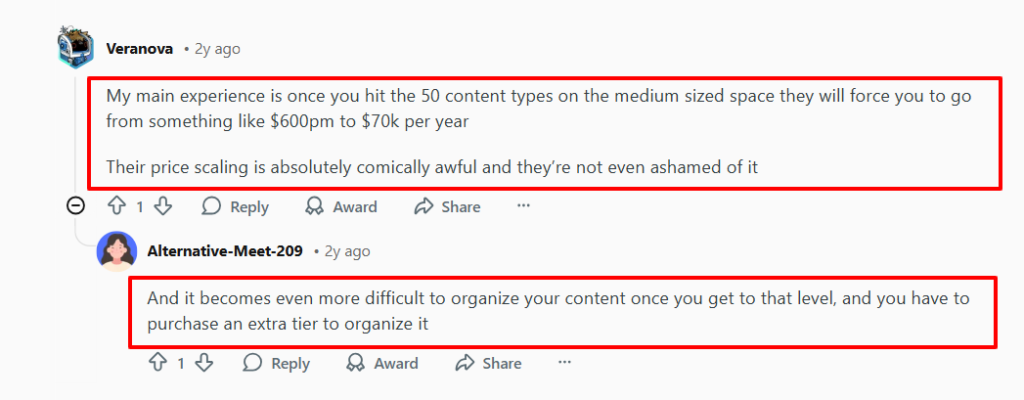
On lower-tier plans, the number of content types is capped, and once you hit that limit, upgrading isn’t cheap. (It can jump from hundreds of dollars per month to tens of thousands per year, according to Contentful reviewers.)
Reddit users say costs jump sky-high, and organizing content at higher levels gets tricky unless you buy the next tier.
A G2 reviewer had the same experience. Their team hit the content model limit on a lower-tier plan, and the only way to get more was to upgrade the whole subscription, even though they didn’t need any of the extra features.
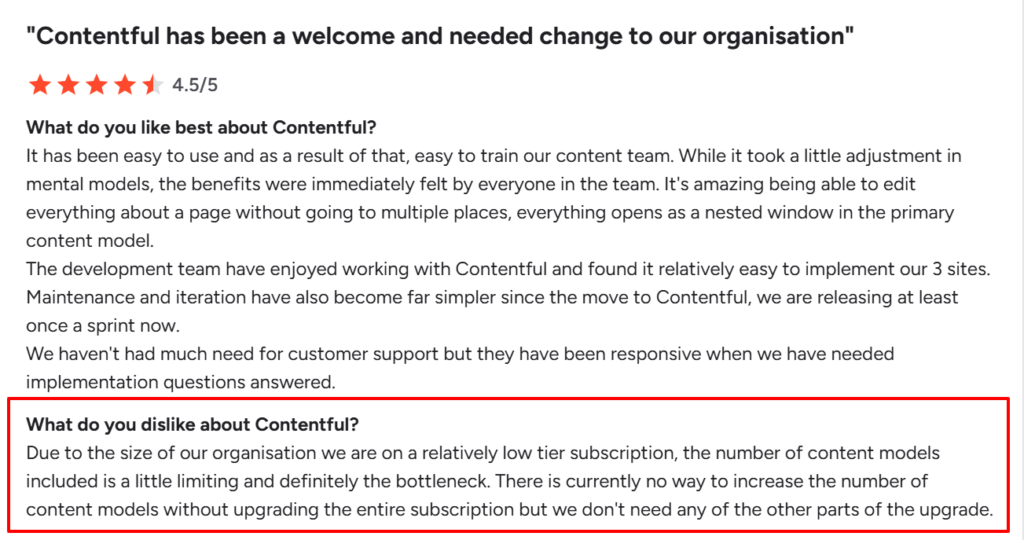
For smaller or mid-sized businesses, hitting the content model limit might not be a big deal.
But for larger websites or enterprise teams, it can quickly become a bottleneck — and a very expensive one at that.
Contentful CMS can feel complex if your development team hasn’t worked with it before.
And if you don’t plan on using a dev team, you’re in for a world of hurt.
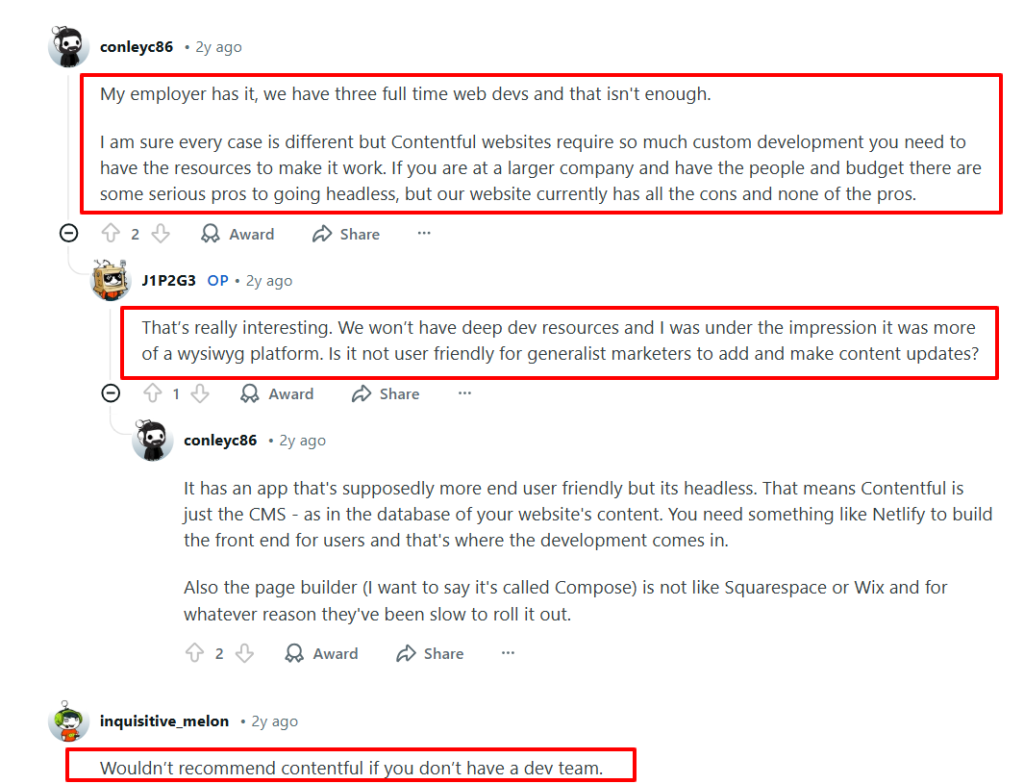
Its site claims you can “customize digital experiences without developer support.” But Redditors’ reviews on Contentful CMS report a different experience.
One Redditor says their employer has three full-time web developers, and it still isn’t enough support. Another user says, “Wouldn’t recommend Contentful if you don’t have a dev team.” 👇
The fix:
Contentful can be helpful for massive organizations like KFC that need content across multiple channels, regions, and platforms, all updated from a single system. But it’s not the best fit for every business or content setup.
Here are some alternatives to think about:
WordPress (important to note that it’s the dot org version) is a classic. It’s a legacy CMS that’s been around since 2003.
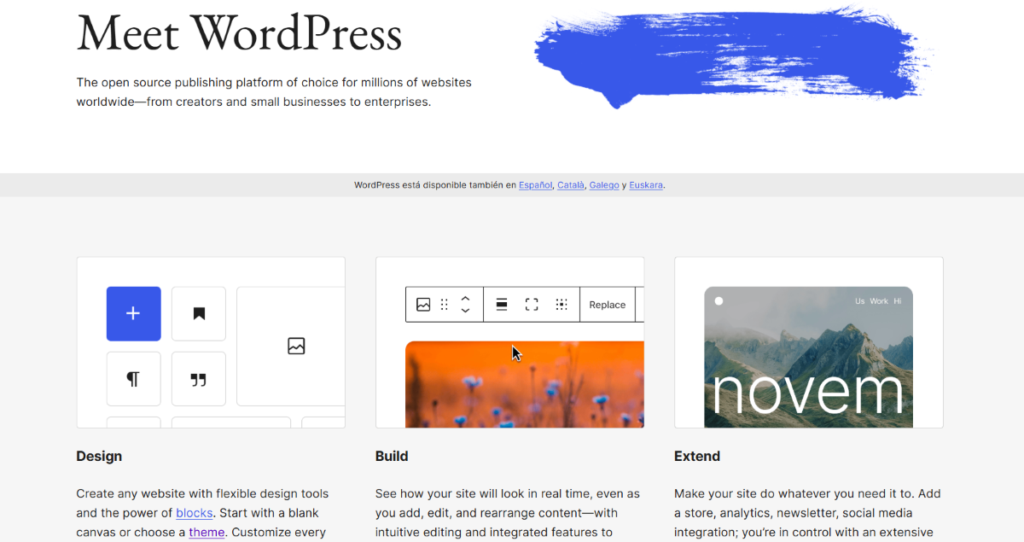
WordPress is also a Content Management System, but it’s not headless. Unlike a headless CMS, where content is stored separately and delivered to different platforms via APIs, WordPress tightly couples content with the website’s front end.
This means your content creation, management, and presentation all live in the same system. (So what you write in the CMS is closely tied to how it appears on your site.) It also integrates easily with common marketing tools like CRMs, email platforms, and analytics software.
Paired with Wordable, it’s really all you need for efficient content management and fast publishing. For most marketing teams, that’s enough to function as a scalable content platform without added technical overhead.
If you haven’t heard of Wordable, it’s a tool that helps you stage and publish your content from Google Docs to WordPress in seconds. Publishing is typically a major time suck when you do it manually since your formatting doesn’t copy over perfectly. Wordable solves that. 💪
Pricing: WordPress.org offers its open-source CMS at no charge, including all updates and security patches. You just pay for your hosting, domain, and theme. And any fancy plugins you might want.
Wordable offers a free plan, which is great if you just have one website and five exports per month. Its most popular plan is $29 per year for five sites and 10 monthly exports. It also offers Pro and Premium Plans. ($149 and $349 per year)
Webflow sits in a nice middle ground between flexibility and ease of use.
It’s not headless in the same way Contentful is. But it gives you more control than traditional CMS setups without requiring a full dev team.
It works well for marketing sites, content-driven websites, and teams that want visual control without touching code every day. You can manage content, design layouts, and publish updates in one place, which keeps your workflows smooth. It also offers strong UI customization options for marketing teams that want visual control without relying heavily on developers.
If your primary goal is a polished website with structured content (and not complex omnichannel delivery), Webflow can be a strong alternative.
Pricing: Webflow offers a limited free plan. Its paid plans range from $18 per month to $49 per month. But for its CMS, you’ll need to choose the $29 per month plan or the $49 per month plan. It’s slightly cheaper if you pay annually.
Contentstack is another headless CMS often compared directly to Contentful. It offers similar API-first architecture, content modeling, and omnichannel delivery capabilities.
That said, some Reddit users mention that Contentstack’s APIs feel less intuitive than Contentful’s, especially for teams new to headless CMS platforms. They also mention that Contentful lacks knowledge base documentation, so you’ll still need experienced developers and time to model your content properly.
If you like the headless approach but want to evaluate alternatives to Contentful’s pricing or ecosystem, Contentstack is worth a look.
Pricing: Contentstack pricing isn’t publicly listed. Contact sales for a custom quote.
Uniform is a composable content platform built within a broader Digital Experience Platform (DXP) framework, but it goes beyond content management alone. It’s designed for teams that want to personalize experiences across channels using customer data, analytics, and experimentation tools.
This makes Uniform a better fit for advanced use cases. (Like personalization at scale or complex customer journeys across multiple touchpoints.) The tradeoff is added complexity and cost.
If you’re already operating at an enterprise level and need orchestration across content, data, and personalization, Uniform can make sense. For simpler content needs, it’s likely overkill.
Pricing: For small businesses, costs start at $12k per year. Mid-size and enterprise pricing plans aren’t listed.
Strapi is an open-source headless CMS that’s API-first.
You get flexibility similar to Contentful, but with more control over your hosting and backend. You can self-host it, or use Strapi Cloud if you want a managed, fully hosted option.
It’s designed for developers and technical teams. But its admin panel is user-friendly enough for content editors to manage entries without touching code. You can create content types, define user roles, set up permissions, and deliver content to multiple platforms via REST or GraphQL APIs.
Because it’s self-hosted (if you choose that route), you get more freedom over customizations and integrations — but you also take on more responsibility for maintenance, updates, and hosting.
Pricing: Strapi itself is free and open-source if you self-host. But it also offers a growth plan for $45 a month, and a custom enterprise plan. Strapi Cloud offers a free limited plan. Its paid plans start at $18 per project per month and go up to $90 per project per month and $450 per project per month.
Cloud CMS is a fully managed, cloud-based headless CMS built for enterprise teams and large-scale digital experiences.
It supports omnichannel content delivery and advanced workflows — so it’s ideal for complex organizations with multiple brands, regions, or products.
Like Contentful, Cloud CMS is API-first, so content can be delivered anywhere. (Websites, mobile apps, kiosks, or other digital platforms.) It also emphasizes workflow customization, granular user roles, and advanced permissions for large teams.
However, its feature set is heavy-duty, which can feel overkill for smaller businesses or simpler websites. It’s a powerful tool, but the learning curve and cost are higher than those of more straightforward options.
Pricing: Cloud CMS pricing ranges from $220 to $1,700 per month.
Curious about other CMS options? Check out these highly popular articles:
Contentful CMS offers flexibility, scalability, and omnichannel content delivery.
But it comes with trade-offs. Its steep learning curve, high costs at scale, and reliance on experienced developers can make it challenging for small or mid-sized teams.
If you need a headless CMS for complex, multi-platform projects, it can be a powerful tool. But if your content needs are simpler, a traditional content platform like WordPress with Wordable is all you need.
The key takeaway: Choose the CMS that matches your team’s technical skills, content complexity, and budget. Don’t assume “headless” is better for every situation. Pick what helps you publish efficiently without unnecessary friction. ✅
Psst. Curious about Wordable? Give it a try here.
Note: Wordable does not integrate with Contentful CMS.
Is Contentful CMS free?
Contentful offers a free tier, but it’s limited. Paid plans start at $300/month and can reach tens of thousands per month for larger teams and more content types.
Do I need a developer to use Contentful?
Yes. While the platform advertises “no developer required” features, real users report that you’ll need a skilled dev team for setup, content modeling, and integrations.
What makes Contentful different from WordPress?
Contentful is headless. It separates content from presentation and delivers it via APIs to multiple platforms. WordPress couples content with the front end, making it simpler for smaller teams but less flexible for omnichannel delivery.
Can I use Contentful without technical experience?
You can, but it’ll be difficult. Planning, onboarding, and ongoing content updates are smoother with developers on your team. For pristine customer experiences, definitely make sure you have support.
What are some alternatives to Contentful?
WordPress + Wordable, Webflow, Strapi, Contentstack, Uniform, and Cloud CMS are Contentful alternatives.
Does Wordable work with Contentful CMS?
No. Wordable is designed for WordPress, so it doesn’t integrate with Contentful.