


I’ve never seen a brand with a solid SEO content strategy fail. Unless, of course, they didn’t implement the strategy. 😂
Artificial intelligence (AI), semantic search, and shifting user behavior have raised the marketing bar. If you want an authoritative brand and an online presence that attracts qualified leads, you need to implement an SEO content strategy.
But you also need the right team on your side. One with solid results (ideally in your industry) and a company culture you align with.
Let’s take a closer look at why you need a content marketing blueprint and which top SEO agencies I’d trust to deliver that. 👇
It’s funny … despite all the new tools, AI platforms, and shiny SEO tactics out there, the thing that drives the strongest SEO results is still original content. And the data backs this up.
The 2025 State of SEO report from Search Engine Journal found that 66.3% of SEO professionals say original content creation had the greatest impact on SEO outcomes over the past year.
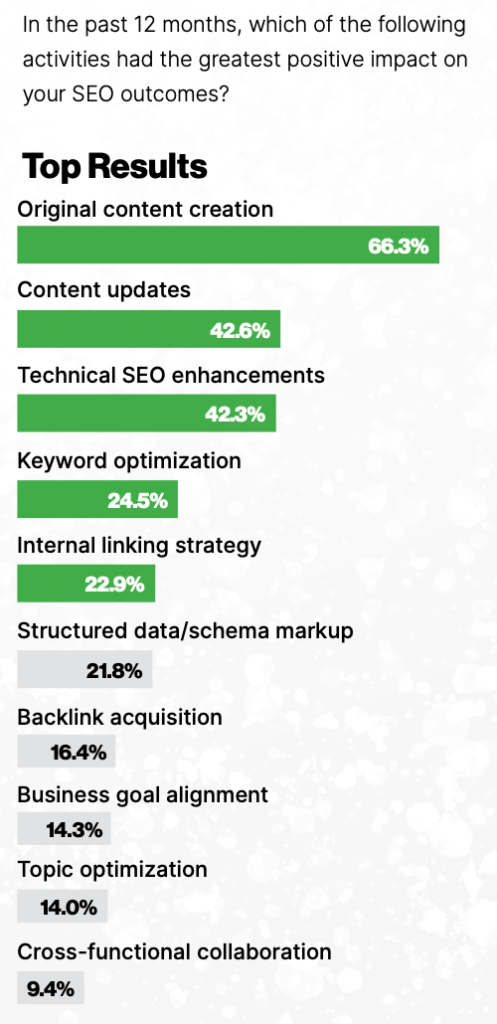
That says a lot. Brands investing in thoughtful, well-crafted content continue to earn meaningful organic visibility.
But here’s the catch.
While original content is still the best, publishing a ton of it isn’t the differentiator anymore.
AI-powered search and semantic understanding are changing how search engines interpret and rank pages.
Matching queries to content works fine on the surface. But now you also need to answer intent, support usability, and help your target personas find what they came for without friction.
Reed Daniels, owner at Rail Trip Strategies, explains it perfectly …
“SEO will continue to evolve with a greater emphasis on user experience, AI-driven search, and voice and visual search optimization […] marketers must focus on creating comprehensive, context-rich answers rather than targeting isolated keywords. Structured data and semantic search will play a key role in helping search engines interpret and rank content more effectively.”
That’s why an SEO strategy matters now.
Your content needs to be useful, purposeful, and genuinely helpful. It needs to guide people from point A to point B in their journey while clearly positioning you as the expert they can trust.
But it also needs to signal that value to today’s AI-driven algorithms. That means content that’s structured, contextual, and easy for search systems to understand.
And it has to be discoverable in more than one way. (Including Google search results, voice search, visual search, social media search, and all of the different ways people now ask questions and look for answers.)
And that’s a lot for a solopreneur or small marketing team to stay on top of.
If I were hiring an SEO content strategy agency today, I’d partner with a team that can support the full SEO content lifecycle and stay ahead of algorithm changes.
That’s where an agency can genuinely make a difference.
Otherwise, you’re expecting your small team to have bandwidth to research, create, optimize, and maintain content at the same time. And that’s hard work.
Here’s how agencies can support you. 👇
If an agency jumps straight into content ideas, that’s a red flag for me. A solid SEO starts with in-depth research first.
The right team starts by digging into:
Every recommendation should have a reason behind it.
If they can explain why a topic matters, where it fits in the strategy, and what outcome it supports, that’s a good sign.
*Pro-Tip: Look for case studies that prove their strategies work.
Great agencies design your website architecture as a structured system.
That usually looks like:
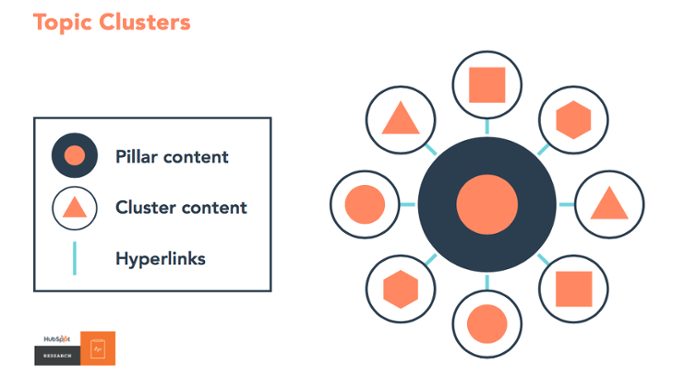
This is where content compounds.
If every idea exists in isolation, it turns into noise. If they build content models, it forges authority and powers momentum.
When I’m evaluating an agency, I want to see that mapping clearly. If they can’t show how a piece connects to the bigger strategy, that’s a sign the plan won’t scale.
The best agencies consider what users want and the content types they prefer.
Sometimes the right approach is a guide. Sometimes it’s visual content. Sometimes it’s video, product-led walkthroughs, or original research.
To me, this is where strategy separates from output.
You want the right format for the right problem. That’s what makes new AI algorithms tick.
Strong agencies offer technical SEO fundamentals to support their content.
They bake technical context into strategy.
This includes:
It’s not glamorous work. But it determines whether content is discoverable at all.
If an agency treats technical SEO as a separate function, I know the content will slip through the cracks.
Great SEOs help you understand the quality behind your website traffic.
When I’m talking to an agency, I want to hear conversations about:
If an agency can explain how strategy turns visibility into meaningful results — great. If they only talk about pageviews and impressions? I’m out.
But beyond that, I’m looking for transparency.
The agencies I rate highest are the ones that treat measurement as part of the learning process rather than simply a monthly reporting task.
I like teams that share insights openly, talk about what worked (and what didn’t), and aren’t afraid to break down their thinking. Like the transparent culture you’ll find in Buffer’s Open publication.
Here’s a list of the top SEO content strategy agencies for 2026. They’re qualified teams, with clear specialties, and repeatable processes.
Each one brings something different to the table, so it comes down to how well you align with each team’s culture and results. 👇
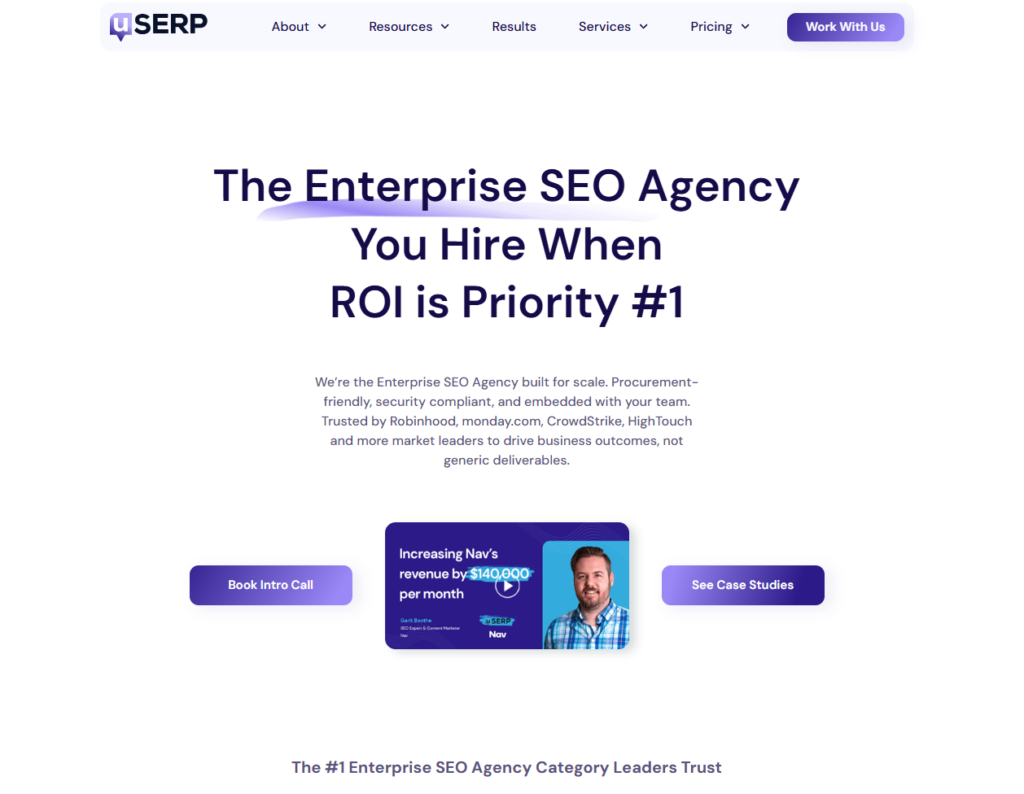
There’s no one I trust more for SEO content strategy than uSERP.
uSERP always starts with a thorough SEO content audit to see what’s already working for your website. They then fill in content gaps so results compound and beat your competitors.
They also create high-intent pages and pieces depending on your target audience’s real searches in Google and AI search. The uSERP team goes above and beyond by sourcing audience research from Reddit, LinkedIn, and other relevant communities.
To help your site rank as soon as possible, they target keywords most agencies gloss over. (Like long-tail, conversational topics and micro-intent queries.)
uSERP also has solid relationships with top publishers and media outlets to help you build high-quality backlinks and domain authority. They publish guest posts and secure brand mentions so search engines, AI, and real users see you as a top industry expert.
On top of this, they help optimize your technical SEO, your site’s user experience, and other important elements, depending on your business. (This might include local SEO, product SEO, and international SEO.)
uSERP’s work has led to multiple companies achieving unicorn status. 🦄 If that’s your goal, uSERP is your ideal partner.
uSERP offers different plans for content, SEO, and link building. Expect to pay at least 10K per month. Contact the team to see which combo works best for your goals.
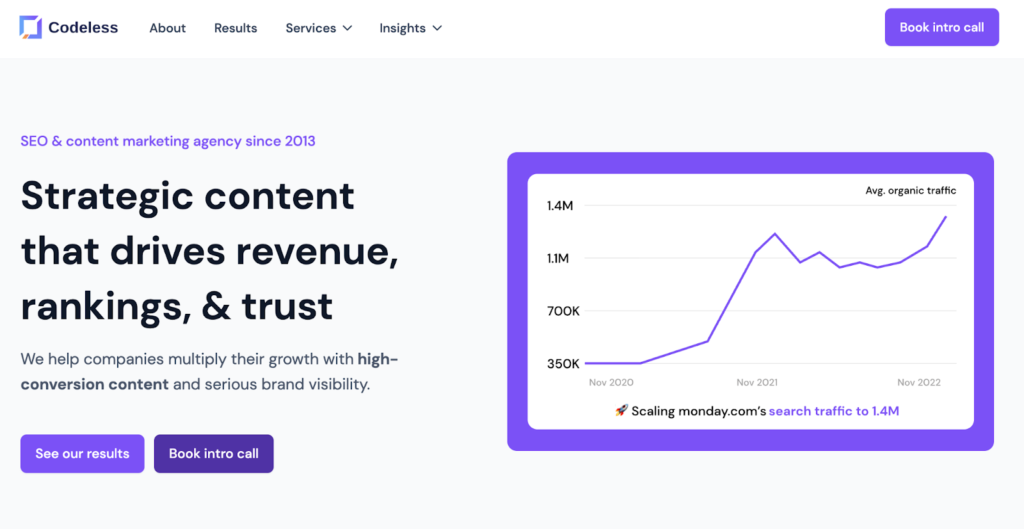
Codeless is a strong choice when you need high-volume, high-quality long-form content without turning your blog into a content mill.
They handle the full written content cycle. This includes strategy and topic research, content mapping, calendars, structured briefs, SME writing, design, and editorial QA. They also offer ongoing refresh cycles to fight content decay.
Their focus is ranking in competitive SERPs while keeping depth and UX front and center.
Tiered plans generally range from $8,000 to $24,000 per month. Custom pricing is also available.
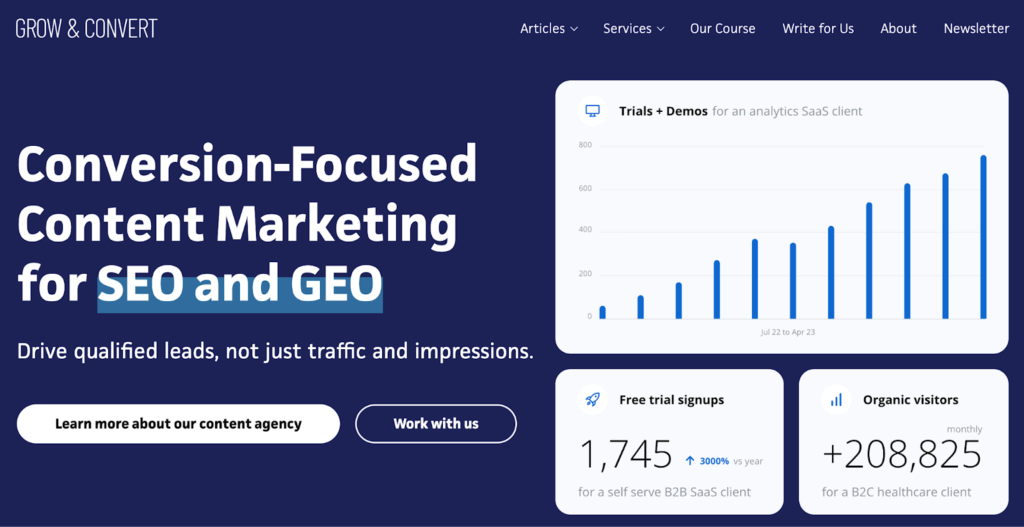
Grow & Convert focuses on conversion-focused SEO, built around pain point SEO and bottom-of-funnel topics that drive pipeline.
Their team handles research, writing, optimization, publishing, and link building. Everything’s backed by analytics, so you can see which pages generate leads and revenue.
They also interview all internal experts to nail your positioning so your content reflects your company perfectly.
Retainers are done on a per customer basis, but expect five figures a month, since their paid search service starts at $3,500.
Omniscient Digital helps B2B SaaS companies turn content into a revenue channel.
Every engagement starts with research sprints across product, competitors, and customers. Following this, they build content models and clusters tied directly to the pipeline, SQLs, and ARR.
Their OmniscientX process blends qualitative and quantitative research, followed by structured production and ongoing optimization.
Full-service retainers generally start around $10k/month, with strategy-led packages often beginning closer to $15k and scaling with scope.
Intergrowth focuses on scalable SEO for startups and SMBs that want real growth without enterprise bloat.
They begin with keyword research and market analysis to size your opportunity.
Using this information, they develop an SEO and content plan, resolve technical issues, and create top-performing content on a clear schedule.
Their process is very systems-driven and collaborative, with monthly consulting baked in.
Typical engagements land roughly in the $4k–$7k/month range, with custom tiers that can extend higher based on volume.
Directive Consulting specializes in performance-driven SEO and demand generation for B2B brands, where everything ties to customer acquisition.
They start by unpacking your buyer personas, product value, CAC vs LTV, and sales cycle. From there, they build search programs that create connected growth. This includes high-intent keywords, revenue-aligned content, technical SEO, internal linking, and digital PR services.
Pricing ranges from startup packages at around $6,500/month to larger pipeline-led engagements.
Clearlink is for brands that need big, multi-channel SEO content programs in competitive spaces.
They analyze your market, competitors, and SERP landscape to find where content volume and quality can have the biggest impact. They then orchestrate SEO, content, paid, CRO, and sometimes sales solutions as one system.
Expect programmatic planning and ongoing optimization that ties to clear KPIs.
Pricing isn’t standardized publicly. It’s heavily customized based on content volume, channels, and the complexity of your vertical.
NP Digital targets enterprise brands that want to expand market share across both national and local search.
They dive into your current visibility, competitors, and margins to understand your global position. Next, they build content clusters, topical authority, and integrated local SEO. This includes Google Maps and location strategy.
One of the major pluses for enterprises is that their focus is on measurable revenue growth beyond SERP ranking.
Pricing is custom and on the higher side, with retainers commonly landing in the high four- to five-figure-per-month range and annual commitments.
The right SEO content strategy partner takes the time to understand your company inside and out. (Your audience, your model, and how growth happens.)
But to bring that together, they need the capacity to support the full content lifecycle. And think further than the old playbooks.
Choose uSERP if you want an agency that’s ahead of the curve and uses it confidently — with metrics, performance, and real results to back it up. 💪
Book a free strategy call now.
Most teams start seeing meaningful movement in three to six months, with stronger compounding results around nine to 12 months.
Timelines depend on your domain authority, competition, content quality, and the consistency with which you publish and update content. But expect a long-term partnership.
Look beyond pageviews.
I look at leading and lagging metrics, such as:
Both can work. In-house is great if you have strategy, writing, SEO, and analytics capacity. Agencies help when you need research depth, content velocity, technical support, or full lifecycle management without overloading a small team.
No. AI can support research and workflows, but strategy still depends on expertise, audience understanding, positioning, and judgment. The brands winning today use AI as a tool, not a substitute for strategic thinking.