


One of the top questions on most founders’ minds is: Should I fund my own business? Or ask for financial support?
Some gurus swear that bootstrapping and figuring things out on your own make you a stronger business owner. Others nudge you toward working with investors, promising that scaling can only happen with them on board.
So … which one is it?
Let’s take a look at this from a financial advisor’s perspective.
In the guide below, I’ve outlined what bootstrapping and funded growth mean, each of their pros and cons, and which one’s best for founders. (I’ve also pulled advice from real people in the trenches so you can make the best choice for your business.) 👇
Bootstrapping for early-stage founders means starting and growing a company with your own savings. You retain ownership over your business, but everything’s on you. (You don’t get any advice or capital from investors.)
Funded growth means raising outside money for your business. This is usually through a pre-seed round (about $200k or less) or a seed round ($500K–$5M).
You usually choose funded growth if you need support with:
If you’re still validating your idea, working with an experienced MVP development company can help you launch faster, reduce development risks, and build a product ready for investor feedback.
This funding often comes from angel investors, accelerators, or venture capital firms.
Some investors stay mostly hands-off, while others want a say in strategy or a seat on your board. You can also bring on advisors and give them small equity shares in exchange for guidance and connections. (These are called advisory shares.)
When it comes to picking between bootstrapping and funded growth, financial advisors don’t immediately steer you into one direction. They run through all of the pros and cons of each choice so you can make the most aligned decision.
Here’s what you’ll learn. 👇
Here are some pros for choosing the bootstrap process over funded growth:
Since you’re more careful with every dollar you have, bootstrapping your business can help you have better margins. You don’t throw money at every shiny new marketing tactic. And you don’t owe investors a slice of the pie either.
(Image by Ioana)
“With bootstrapping, you pace yourself. You think about healthier margins because you don’t have so much capital available,” says Fernanda Baker, Executive Director in Startup Banking at J.P. Morgan.
With bootstrapping, YOU’RE the boss. You don’t have investors giving you business advice that you don’t align with. And you don’t have to run your ideas or decisions by anyone.
If creative freedom and strategic direction are your biggest priorities, bootstrapping is likely the better path for you. (Note: If you co-found your business, you’ll obviously have a business partner who’ll have a say.)
Since bootstrapping is rooted in self-reliance, founders retain 100% ownership. This means you also keep all profits and control over your company.
Stephen Turban, Co-Founder at Lumiere, says VC-backed founders get jealous of bootstrapped founders.
“I get jealous of VC-backed founders for their sexy advisors and TechCrunch articles.
But every time I talk to a VC-backed founder, I find that they tell me the same thing. “You’re doing it the right way.” Or “damn, I wish we could do that.”
(Image by Ioana)
The grass is always greener. They often lust after the freedom, the control, and the fundamental economics of a business that cash flows well.”
Here are some cons for choosing the bootstrap process over funded growth:
If you’re launching in a highly competitive industry, there’s a race to market. But bigger competitors have more resources and can speed up their product launches. If they get the first cut, you can lose out on share of voice, visibility, and profit.
“In fast-moving industries, speed can be critical,” Fernanda says.
“If you take too long to launch, competitors might be launching faster than you and gain market share.”
Depending on your business model and industry, starting a business can be very expensive. And if you quit your day job, you’ll be working to replace your salary and grow the business.
That’s a tall order for a concept that may not be proven yet.
“Whatever you think your pain threshold is, you should double it,” says Andrew Beebe, a venture capitalist at Obvious Ventures. (Andrew co-founded two tech startups before becoming a VC.)
Most small business owners (70% to be exact) use personal savings to fund and grow their businesses, according to the US Chamber of Commerce.
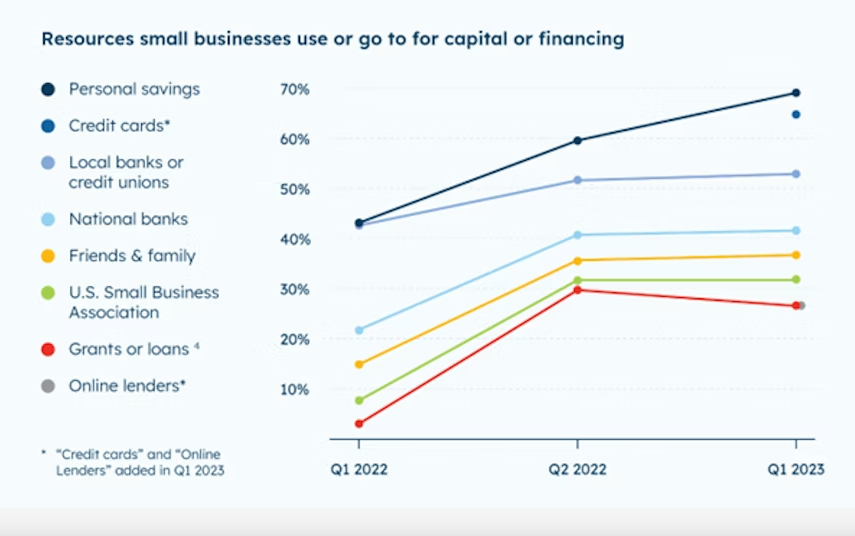
If your business goes well, or you work a day job or side job, this may not be a big deal. But if you’re draining your savings without any profit in sight, your business can quickly become a money pit.
This becomes even more painful if you’ve taken out high-interest credit cards, loans, or mortgaged your home to keep the business afloat.
You may be left with a lost dream, no money in the bank, and a pile of personal debt. 💔
If you do use banking products,try to get the lowest interest rates possible. (Before using credit cards, get expert credit card advice so you can choose a card that gives you time to pay without interest, and makes tracking your expenses simple.)
Here are some pros for choosing funded growth over bootstrapping:
Funding lets you scale faster than you could on your own. You can hire key team members, launch marketing campaigns, and expand operations without waiting for revenue to trickle in.
If you’ve ever watched SharkTank, you’ve seen how capital and the right investor can accelerate execution and growth. Just one infomercial, QVC ad, or partnership with a major player like Walmart can help a business generate millions in mere months.
When investors put money in, they have skin in the game.
This can incentivize them to provide strategic guidance, help refine your business model, and open doors to partnerships or clients you couldn’t reach alone.
If you go this route, make sure to have an advisory share model or a formal agreement that clearly states their role is to provide advice and guidance, along with capital.
When VCs back your startup, it boosts your credibility. (Helloooo clout!) You can announce the funding through press releases and your online channels, which helps build trust with customers, partners, and future investors.
(Image by Ioana)
“Raising capital can be a stamp of approval and give you legitimacy,” says serial entrepreneur Joe Beninato. (Joe’s founded or cofounded four startups and worked for four others.)
Here are some cons for choosing funded growth over bootstrapping:
When you’re in the early stages, there’s still a lot to prove.
Unless your product or service goes viral overnight, you may not have all of the metrics investors want yet. For example: A low customer acquisition cost (CAC), healthy margins, and steady year-over-year (YoY) revenue growth.
If you’re spending time building pitch decks and meeting with investors and it never goes anywhere … that’s time you could’ve spent growing your business.
One bootstrapped founder on Reddit says:
“I’ve applied for a number of accelerators for my startup, but I find them to be so competitive, and the folks are too choosy. I have a great business model, and I’m really looking forward to proving them all wrong. Bootstrapping FTW and can’t wait to own 100% of what I’ve built. Their loss!”
*Pro-Tip: Get a feel for the investor’s decision-making framework before pitching your business plan. Learn what they look for and show them that your business meets that criteria.
Taking on investors brings expectations. Once capital is in, you’re accountable not just to yourself but to your backers. This can create pressure to hit aggressive growth targets, meet milestones, and deliver returns on their timeline.
For early-stage founders, this pressure can lead to stress, rushed decisions, or prioritizing short-term metrics over long-term strategy.
If you choose funding, try to use this pressure to your advantage. (Let it light a fire under you to make sure your dream succeeds.)
The earlier you ask for funding, the more it costs you later.
Many advisors recommend establishing clear milestones and growing your valuation before raising outside capital. (So you give away a smaller share of the company.)
When you raise money, investors buy a percentage of your company based on its valuation. If your company is worth more, you can raise the same amount of money while giving away a smaller percentage.
(Image by Ioana)
Joseph J Raetzer, MBA, JD, ex-Wall Street lawyer, says: “Every equity point you give away in early rounds costs you exponentially at exit.
Give away 45% in the seed round? Expect dilution to 20-25% by Series B.
At a multimillion-dollar exit:
40% ownership = millions more
20% ownership = significantly less
It’s the same company with the same exit, but millions in difference.”
A creative way you can grow your money without giving up ownership is by investing. Just make sure to time the market well and choose the right products. Ask your financial advisor for support here. You can also use LuxAlgo’s trading indicators to make smarter moves in the stock market. LuxAlgo’s tools help you see market trends and pick better times to invest.
The answer to this question is different for EVERY entrepreneur, given their unique financial situation and goals.
But in general:
➜ If you’re looking for slow and steady growth, 100% ownership, and proving your business works first, consider bootstrapping.
➜ If you’re looking for fast growth, advisory, and capital, then consider funding.
(Image by Ioana)
Billionaire and serial entrepreneur, Mark Cuban, says: “90-95% of businesses can start without raising any capital at all. You just use sweat equity.”
He recommends running your business on nights and weekends after work. Or taking on a side job, like bartending, while building your company. (And grinding until you prove your business is profitable.)
You can also get creative with stacking up cash. For example, sell a non-running car in your driveway, offload old jewelry you never wear, or sublet unused office space. Even a $500–$1,500 boost can cover your software subscriptions or materials for your MVP.
Once you’re profitable and stable, consider if you’re looking for:
If your business is soaring, you may never need to ask an investor to get on board, unless you’re ready to exit. If you’ve hit a wall and need support expanding, investors with the right business relationships can be invaluable.
Serial entrepreneur Andrew Wilkinson also says many businesses don’t need funding.
He recommends choosing funding if you’re in a hyper-competitive market and have a very ambitious goal.
(Image by Ioana)
“How hairy do you want your big, hairy, audacious goal to be? If it’s I’m gonna start the next satellite business that creates some sort of crazy technological revolution, yes, you’re going to have to raise venture capital, unless you’re already a billionaire,” Andrew says.
But if you’re looking to solve a problem in a less competitive market (e.g., launching a contact form business) Andrew says you can still scale your company into hundreds of millions of dollars without any funding at all.
“We bootstrapped the entire business, and now across all of our companies, we do over 300 million dollars in revenue.”
Important Note: Make sure to meet with a financial advisor before making any investment decisions. This article is a general guide, not hard financial advice.
Deciding between bootstrapping and funding looks different for each business.
If you want full control and steady growth, go solo. If you need speed, advice, and extra capital, bring in investors.
You can even mix strategies: Start small, prove your idea, then scale with support. (You’ll also give away less of your business since your valuation will be higher.) And remember, creative ways to grow cash, like selling unused stuff or investing, can give your startup a boost without giving up equity.
Meet with an advisor for a plan tailored to your goals.
Is bootstrapping better than raising venture capital?
It really depends on your business. Bootstrapping works well if you can start making money early and want to grow without spending too much. VC funding makes sense when you need to scale fast and already have the numbers to back it up.
Working with VC-ers also means more networking opportunities. The right connection can change your business overnight.
How do bootstrapped founders pay themselves?
Typically, through early revenue, the business can support salaries. Many take minimal pay until margins and recurring revenue are stable. Read blog posts by real founders who’ve bootstrapped their businesses to learn more about how they pay themselves.
How long does it take to bootstrap a startup?
Usually longer than funded growth. Bootstrapped startups prioritize profitability over speed, which extends timelines but reduces financial risk.
Setting up the right ad funnels and marketing automations can help you grow faster.
*Pro-Tip: Don’t get caught up in long, expensive processes. Fancy website builds, for instance, are a major expense and time suck for new businesses. Use an SEO-friendly website builder for small businesses instead. You can always upgrade your site later.
What are the main risks of bootstrapping?
Slower growth, limited hiring, founder burnout, and personal financial exposure. Even a solid business plan can go nowhere if there’s not enough support or cash flow.
Make sure to have a high cash runway. It keeps you covered for unexpected costs, lets you hire and grow strategically, and prevents survival-driven decisions that can derail your plan. (Aim for at least 12–18 months.)
You might also look into investing or fintech trends, like buying cryptocurrency ETFs, tokenized funds, or digital assets.
What types of startups are best suited for bootstrapping?
The best startups suited for bootstrapping usually include:
If your business plan is simple and you have modest growth goals, bootstrapping is probably the better choice.
Can a bootstrapped startup raise funding later?
Yes. Many founders bootstrap for traction first, then raise when they have recurring revenue at higher valuations with less dilution. This is also the better choice if you plan on selling your business one day.