


The investing world now feels like it lives in your pocket. What used to mean calling a broker and wiring a big chunk of cash now happens inside a trading app in a couple of taps, often with no account minimum at all.
That sounds great, but there is a tradeoff. More platforms, features, and options also mean more noise and more ways to slip up.
This guide breaks down the best brokers for beginners in 2026. You will see what really matters when you open your first brokerage account. You’ll know how to dodge common beginner mistakes and where sneaky fees usually hide. That way, you can start investing with a clear head instead of second-guessing every move.
Brokers are financial services firms that can shape your entire investing journey. The right one teaches as you trade and keeps things calm. The wrong one leaves you confused, frustrated, and scared to click the buy button.
Learning to invest is not a one-time event. It takes repetition, simple examples, and clear explanations. It’s like growth marketing, as you need to keep growing (learning) while monitoring and building your investments.
That’s why the best brokers for beginners go beyond a basic trading screen. They offer easy-to-follow educational resources that explain how to build a portfolio, understand risk tolerance, and read basic market trends.
Many also give you access to demo accounts or paper trading modes. You can practice with virtual money first, get used to how orders work, and only then risk real cash.
According to Schwab’s 2024 Modern Wealth Survey, 51% of Americans who feel confident in their investment strategy say it’s because financial advice and knowledge are readily available. That’s how strongly education and support matter for new investors.
Trading costs may look tiny on a single order, but they add up over time. Commission-free trading on stocks and ETFs is standard now. But, you still have to watch account minimums, interest on margin accounts, inactivity charges, and transfer or wire fees.
Some brokers charge extra if you want broker-assisted orders or advanced order types. Before you open an account, scan the pricing page on each broker’s website. Then see how your trading style, balance, and preferred account type affect your fees.
A clunky platform makes everything feel harder than it should. Good online brokerages keep their web platform and mobile stock trading apps consistent. This way, you don’t have to relearn the layout on every screen.
You should be able to see your portfolio value, available cash, and recent trades without digging through menus. Placing or canceling an order should feel straightforward. It shouldn’t feel like you’re navigating a maze.
When you are new to the stock market, extra steps and clutter only raise the odds of a mistake.
Diversification helps one bad pick avoid wrecking your whole account. At a minimum, look for access to stocks, ETFs, mutual funds, and bonds, plus retirement accounts such as IRAs.
Fractional shares are especially useful for beginners because they let you own a slice of expensive securities with as little as ten or twenty dollars. That makes it easier to build a balanced mix instead of betting your full balance on a single company.
Beyond direct investment options, some brokers can even help you find better rates on savings accounts so your idle cash grows a little faster while you plan your next move.
We focused on real-world use, not just polished marketing pages. For each brokerage platform, we reviewed account types, test trades, and tools with one simple question in mind:
Could a complete beginner use this platform without feeling lost at every step?
We then used a clear methodology to score each broker on education, fees, Trading costs, account minimums, and safety. Every broker in this guide carries SIPC insurance on eligible assets and is regulated by the SEC and FINRA.
After comparing features, fees, and real user experience across major online investment platforms, these brokers stand out for beginners.
Fidelity blends what a new investor needs with plenty of room to grow. Fidelity has the backing of decades of experience and trillions in client assets.
You pay zero commissions on stocks, ETFs, and online options trades, with no account minimum.
Options contracts cost $0.65 each, and some mutual funds carry a transaction fee. Margin rates for smaller balances are around 12.075% and drop as your balance rises (based on a base rate of 10.825%).
Most basic account services are free, which helps keep overall trading costs low.
Beginners who want deep research tools, strong educational content, and room to grow into more complex investment strategies.
If you are still learning the basics of stock purchases and sales, Fidelity’s guides and tools can make each step feel less intimidating.
Charles Schwab helped popularize discount brokerage in the 1970s. It now supports more than 38 million accounts across the U.S. markets.
You pay zero commissions on stocks, ETFs, and base options trades with no account minimum.
Options contracts cost $0.65 each, while margin rates hover around 12.075% for smaller balances and drop as you hold more. Some specialized order types or services might carry extra fees.
Investors who value a mix of powerful tools and personal guidance, plus those who want banking and trading under one roof.
Interactive Brokers gives you access to over 160 markets worldwide and appeals to active traders who need speed and flexibility.

You can choose low-cost tiered pricing on U.S. stocks, with per-share commissions that fall as your volume grows, or a fixed-rate pricing plan. Many U.S. exchange-listed stocks and ETFs are also eligible for $0 commission under IBKR Lite.
ETFs and options trades follow a similar structure. Margin rates for IBKR Pro start around 5.38% (for balances up to $100k) and scale lower with larger balances. IBKR Lite rates are slightly higher at around 6.38%.
Global trades carry small commissions based on each market.
Active traders who want worldwide market access, low margin rates, and flexible trading tools. Many approach it with the same discipline they bring to developing a content marketing strategy: test ideas, track results, and refine over time.
E*TRADE sits between beginner-friendly and feature-rich. It combines a simple interface with deeper tools for investors who want to grow.
You pay zero commissions on stocks and ETFs. Options trades cost $0.65 per contract, mutual funds may carry loads or transaction fees, and margin rates start around 12.70%.
There is no minimum to open an account, although you need at least $2000 equity for margin privileges.
Beginners who like a clean platform but want the option to explore advanced features later. Think of it like building an SEO and content marketing plan: you can start simple today and layer on more advanced tactics as your skills grow.
Robinhood changed investing by dropping commissions and making trading feel as simple as scrolling social media.
You pay zero dollars to trade stocks, ETFs, and crypto, with no account minimum.
Options trades have no commission fee, but Robinhood charges a combined regulatory fee of $0.04 per contract to cover costs.
The paid Robinhood Gold membership runs $5 per month for perks such as higher instant deposit limits, better margin rates, and access to professional research.
Younger investors who value a simple app, fast access to funds, and cryptocurrencies in one place.
Vanguard created the first index fund in the 1970s. Today, it still focuses on low-cost, long-term investing, which makes it a go-to choice for buy-and-hold investors.

You pay zero commissions on most online trades of Vanguard ETFs and many U.S. stocks. Some accounts may have small annual service fees, which can often be waived by choosing e-delivery or meeting minimum balance requirements.
Mutual funds from other companies may include transaction fees or higher investment minimums.
Long-term investors who care most about low trading costs, retirement savings, and broad blue-chip stocks exposure through S&P 500 stocks and Vanguard ETFs.
Webull targets tech-savvy investors who like advanced charts and tools in a clean, modern interface.

Their SEO content production is top-notch, with charts and data that make it easier to understand what’s changing in different markets.
You pay zero commissions on U.S.-listed stocks, ETFs, and options with no account minimum. There are no per-contract fees on stock and ETF options, while index options carry a small $0.55 per-contract fee.
Cryptocurrency trades are priced via a spread, and margin rates are tiered by balance.
Tech-friendly beginners who enjoy exploring charts and data while keeping fees low.
Ally Invest brings banking and investing together so you can manage everything in one place.

You pay zero commissions on stocks and ETFs. Options trades cost $0.50 per contract, and there is no account minimum. Margin rates start low and drop further as your balance grows.
Beginners who want banking and investing in one login so they can move cash quickly and track goals in a single portfolio.
Dhan offers a technology-first approach to investing with a fast and intuitive experience designed for both beginners and advanced traders.
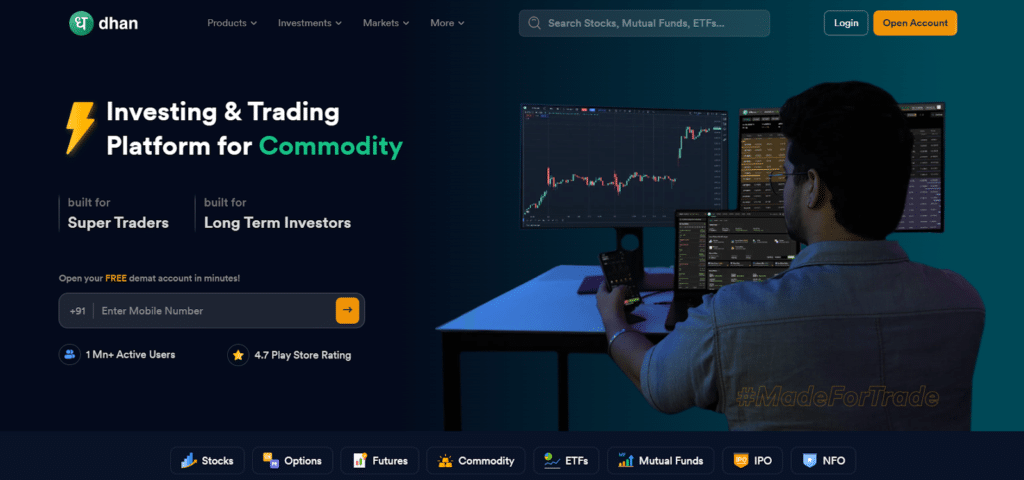
You pay zero rupees to open a Demat account with zero annual maintenance fees. Equity delivery trades, ETFs, Mutual funds, and IPO investments are commission-free, with no account minimum required.
For equity intraday trades and equity MTF, the fee is ₹20 or 0.03% per executed order, whichever is lower. Options and futures trades across equity and commodities have a brokerage of ₹20 per executed order.
Tech-savvy beginners who seek lightning-fast trade execution with advanced charting and features with transparent fees. With Dhan, you can get started in a simple way and add more sophisticated trading strategies as your knowledge of the stock markets increases.
Most new investors run into the same problems. They chase hot tips, jump in without enough research, or lean into day trading because it feels exciting. Putting too much money into one or two stocks can leave your portfolio exposed when a single company stumbles instead of keeping you protected with diversification.
According to Vanguard research, a $100,000 investment in a broad U.S. stock market index from the 1980s to 2024 could grow to about $4.9 million if you stayed fully invested. Miss just the 10 best days, and the final value is less than half. Emotional trading (panic-selling during dips or buying on hype) makes it easier to miss those key days and can derail your investing journey.
Ignoring fees is a quieter problem, but even a 1% drag can cost you tens of thousands of dollars over time. Just as smart content marketing tools keep teams organized, simple rules and written investment strategies help investors stay on track when markets get noisy.
Choosing the best brokers for beginners gives you clear education, low fees, and simple platforms so you can focus on your plan instead of fighting clunky tools.
When you are ready to grow traffic and authority, invest in content marketing resources that help your business compound alongside your investment portfolio.