


Wishing you had a killer content team?
I don’t blame you.
Great content looks easy from the outside. But behind every strong blog, resource center, or SEO program, there’s usually a messy mix of strategy, assignments, drafts, edits, publishing tasks, reporting, and updates.
That’s why how you structure your content team matters. Without clear roles, even talented people end up duplicating work, missing deadlines, or owning tasks that were never really theirs to begin with.
Luckily, I’ve been collaborating with fabulous content teams of all shapes and sizes over the last six years. I’ve seen how internal teams operate, what hierarchies are at play, and how outsourced team members fit in.
And I’ve put together my insights for you in this helpful guide.
Let’s take a closer look at what roles exist within a content team structure — and how to build your own using 10 essential layers. I’ve also included a handy table with five org charts, so you can pick the one that best fits your company. 👇
Highlights
Depending on your company size and goals, your content team might include: SEO specialists, content strategists, writers, editors, and social media managers.
That said, not every business needs every role.
Your goal is to cover all 10 content layers I’ve laid out below.
Most teams don’t need 10 separate hires right away. The point is to ensure every responsibility has an owner, even if one person covers multiple roles in the early stages.
That structure matters more than it might seem. Research from CMI found that 45% of B2B marketers lack a scalable content creation model.
Making sure each layer has a clear owner helps prevent that from becoming your problem, too, even if one person is handling multiple responsibilities early on.
Think in these 10 fundamental layers when building out your content team. 👇
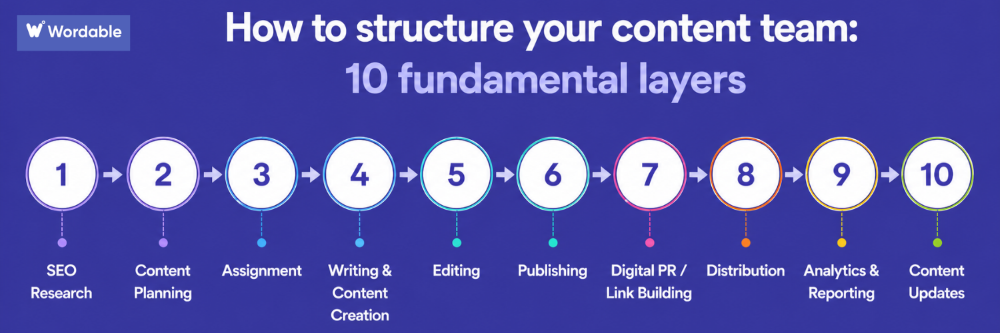
(Image by Ioana)
The first layer in your content team structure is always SEO research.
At this stage, your SEOs should:
Take this stage very seriously because it affects every decision that follows. Without it, you risk investing time in topics that may never drive qualified traffic or revenue.
The best roles for SEO research include: SEO strategists, SEO managers, and keyword researchers.
After SEOs identify opportunities, the next step is to turn their insights into a content marketing strategy and plan.
The content planning stage determines what gets created, when it gets published, and how each piece supports your broader business goals. It bridges the gap between SEO strategy and content production.
Your content planners should:
Common roles for this stage include: Content strategists, content managers, and marketing managers.
At this point, you know what content you’re creating and when it needs to be published.
The next step is assigning each project to the right person.
During this stage, your assignment team should:
Helpful roles for the assignment stage include: Content managers, managing editors, and project managers.
*Pro Tip: Make sure each content brief answers most questions before content creation begins. Include the target keyword, target audience, a style guide, and instructions.
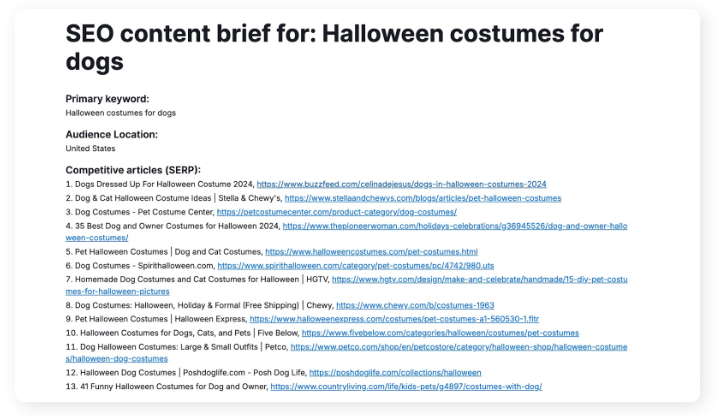
Now it’s time to create your content.
This is where writers and content creators turn your strategy into valuable content that attracts, educates, and converts your audience.
That quality bar matters. Statista research shows that creating high-quality content remains one of the biggest challenges for content marketing teams worldwide.
That’s why the writing layer needs more than a blank brief and a deadline. It needs clear direction, subject-matter input, and sufficient editorial support to turn strategy into something people actually want to read.
Your content creators should:
Content production roles on marketing teams may include: Content writers, copywriters, subject matter experts (SMEs), technical writers, freelance writers, designers, and video creators.
Once the first draft is complete, the editing stage helps make sure it meets your quality standards before publishing. Editors check whether the content delivers its promise, answers the audience’s questions, and supports your business goals.
This is also where a good content team protects the reader experience. Editing shouldn’t just catch typos. It should ensure the argument holds up, that the examples actually add something, and that the final piece reads as if it came from a single consistent voice.
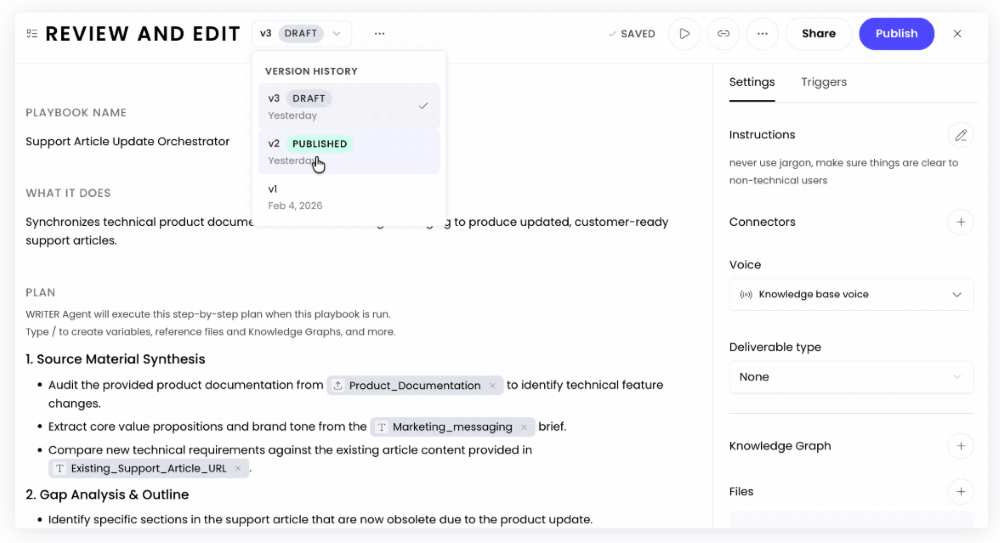
They also:
Editing roles on content marketing teams include: Directors of editorial, managing editors, editors, and content managers.
Once content gets approved, it gets prepared for publication.
At this stage, your team uploads content to the CMS, formats it correctly, and checks every technical detail before publication. ✅
Your publishers should:
The best roles for publishing SEO content include: Stagers, content managers, CMS specialists, and website managers.
Psst … If your team publishes content in WordPress, I highly recommend using Wordable to streamline the process. (It helps your team spend way less time fixing spacing, headings, images, and links after upload.)
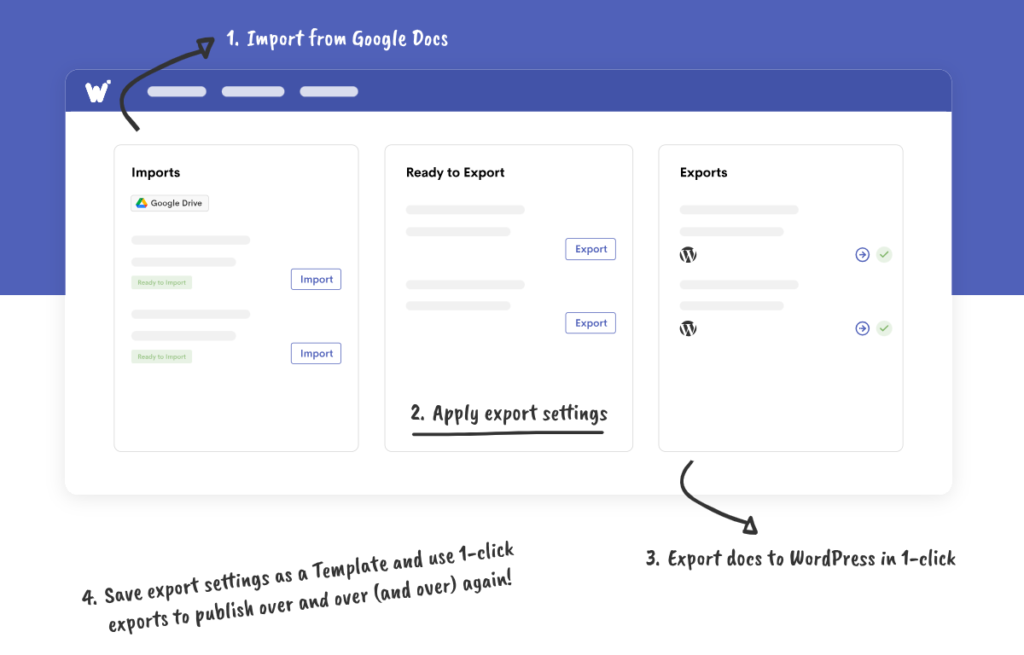
Publishing content is only half the battle. You also need to help people discover it.
The digital PR and link-building stage focuses on earning backlinks, securing media mentions, increasing brand visibility, and driving referral traffic. Its primary goal is to increase your content’s authority and reach after publication.
At this stage, your digital PR team should:
Digital PR and link-building roles include: Digital PR specialists, link builders, outreach specialists, PR managers, partnership managers, and content marketers.
Distribution helps you reach audiences who may never discover your content through search engines.
This stage focuses on sharing recently published content and repurposed content across the channels where your audience already spends time.
Your distribution team should:
For example, your team can turn a single blog post into multiple LinkedIn posts, email newsletters, infographics, and short videos.
Distribution roles include: Social media managers, content marketers, email marketers, community managers, and distribution specialists.
Without measurement, it’s impossible to know whether your content is working.
In this stage, you’re tracking content performance, identifying what’s driving results, and uncovering opportunities for improvement.
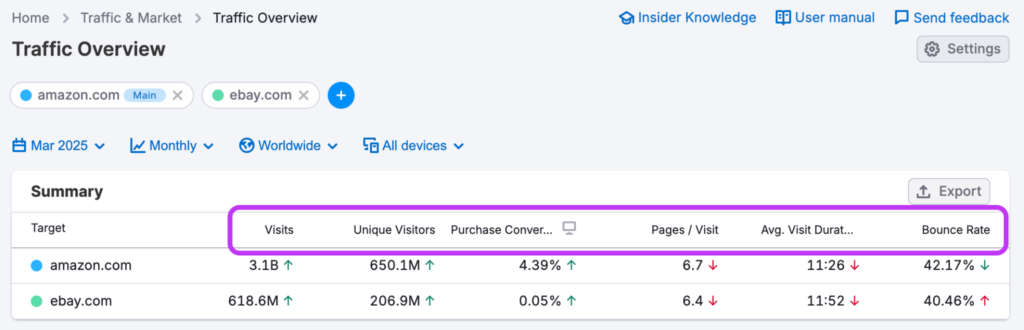
Your analytics and reporting team should:
Common roles for SEO analytics include: SEO analysts, marketing analysts, content strategists, SEO managers, and growth marketers.
To maintain rankings and performance, it’s vital to regularly revisit and improve your existing content. (I recommend doing this quarterly or every six months.)
The content updates stage focuses on refreshing, optimizing, and expanding your published content. The goal is to keep your content accurate, competitive, and aligned with current search intent.
During content updates, your team should:
Roles that help with content updates include: Content writers, SEO specialists, content managers, editors, and content strategists.
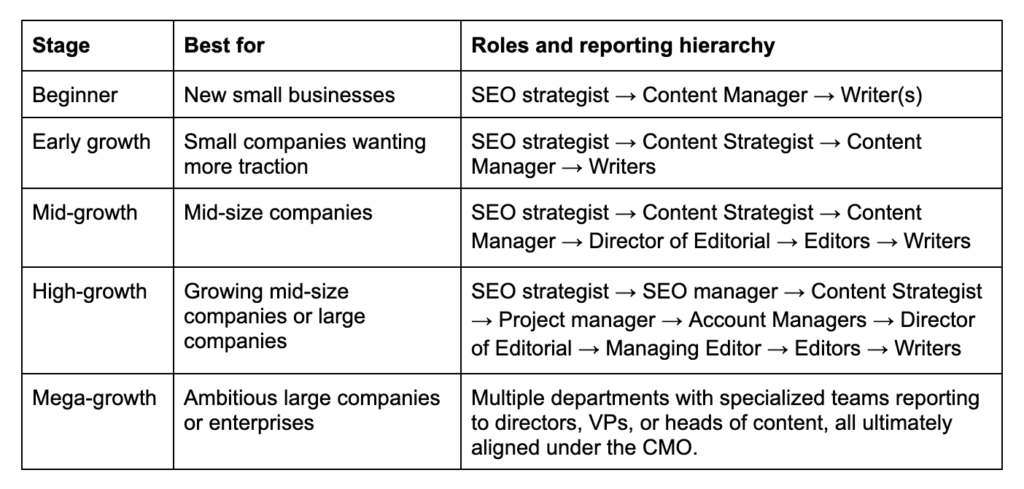
The 10 layers above operate the same way, no matter how large your organization is. What changes is how many people own those responsibilities and which specialists you choose to hire.
If you own a startup, you might have one person covering five layers. If you’re leading an enterprise company, you might have multiple specialists working within a single layer.
Here’s what this can look like at different growth stages to inspire your own team:
(Image by Ioana)
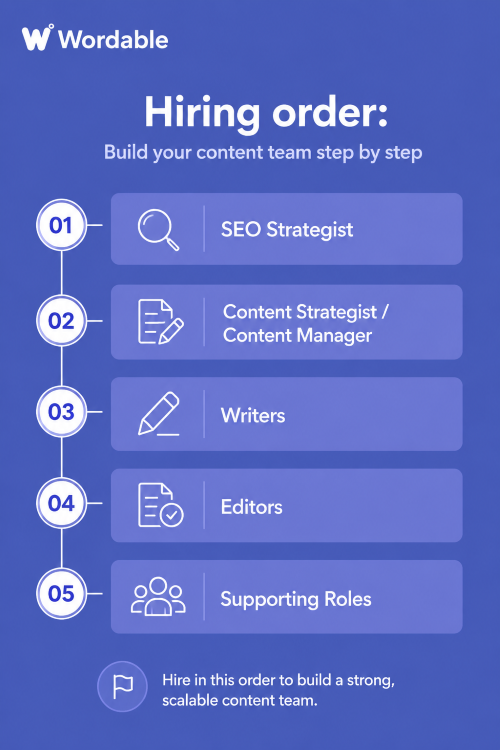
When you’re ready to hire, start with your SEO strategist. Then hire your content strategist or content manager. These team members lay the foundation for your content strategy (and, honestly, they need time to dig into the data!).
While they’re mapping out your SEO approach, hire your writers, content creators, and editors. Take your time to find subject-matter experts and editors who have experience in your niche.
Finally, hire any supporting roles you might need.
(Image by Ioana)
Make sure to train your team on your workflows so it’s clear to everyone how production will work.
After you’ve chosen your org chart, hired for the roles you need, and trained everyone, I HIGHLY recommend giving your team autonomy over their responsibilities. This is a key pattern I’ve noticed across the best content teams I’ve worked with.
I love what content strategist Justin Wagner recently said:
“Autonomy and trust within your structure is everything. Set the standard, then get out of the way. Clear expectations matter, but micromanaging kills creativity. Once the framework is aligned, give them ownership. That trust is what separates good teams from great ones.”
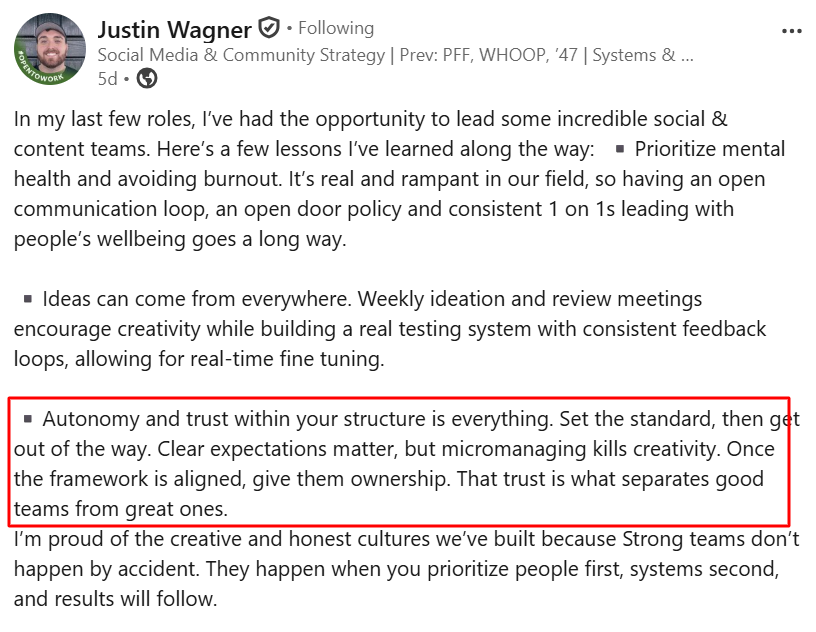
Autonomy only works when ownership is already clear, which is why the 10-layer structure above matters.
Now, over to you.
Copy and paste the 10 layers above into a new doc, or add them to your content production SOP.
Then, use the table above to pick your ideal org chart, hire for the roles you need, and create your workflows.
Once the structure is clear, the publishing layer becomes easier to standardize. If your team needs help moving approved Google Docs into WordPress without manually reformatting every heading, image, and link, Wordable can shave hours off staging each week.
Give Wordable a try now to see how it works. 💪
Common roles include: SEO strategists, content strategists, content managers, content writers, editors, and social media managers.
Growing companies often add specialized roles in each marketing department. These might be digital PR specialists, outreach specialists, email marketers, and technical writers.
It depends on your company’s size. Small businesses usually have a content marketing manager, head of marketing, or founder leading content efforts.
Larger companies may hire a head of content or director of content to oversee content strategy, production, distribution, and performance. These leaders often report to the CMO.
Building a team in-house or outsourcing can both work.
Many small business owners start with a lean team and hire freelancers to create engaging content. As their content needs grow, they gradually build an in-house team and outsource to specialized support where needed.
If you know you need a full content operations team (and you don’t want to take it on yourself), reach out to a content agency. I love uSERP and Codeless.
Most small businesses don’t need specialized roles for every function. One content manager could technically handle keyword research, content strategy, publishing, and reporting. (Though, not perfectly!)
They might also work with content writers and a few freelancers to maintain content quality.
To align content marketing efforts with business goals, develop a content strategy that supports them.
Make sure to set marketing goals that match those objectives. (E.g., Every content piece should have a clear purpose — whether that’s generating leads, increasing visibility, supporting email marketing, or driving business growth.)
Strong processes make quality easier to maintain as the team grows.
Use clear roles and responsibilities to help everyone stay aligned. Content briefs, editorial reviews, content audits, and documented workflows also help prevent standards from slipping.
A content marketing manager typically oversees content planning and assignments. They also create content briefs and SEO briefs. They manage the content calendar and collaborate with different departments to support your broader marketing strategy. (Sometimes they help with publishing and reporting.)