


Over the last 20 years, I’ve learned how to write testimonials that reflect real client experiences.
For reference, I’ve worked with wedding photography clients, TEFL clients, and (of course) content writing clients.
As a service provider, business cards and a sleek website have only gotten me so far.
But testimonials? Testimonials have helped me secure retainers, long-term partnerships, and clients that I’ve kept for 6+ years.
While some of my clients write their testimonials from scratch, many have asked me to craft them myself. It makes sense — they’re not writers! (Plus they’re swamped, so I’m happy to do it.)
Funny enough, leads have referenced these exact testimonials when they DM or email me. And I want to help you get the same results.
Here’s how I write testimonials that sound genuine and build trust with potential clients.
Highlights
According to BrightLocal’s 2026 research, 41% of consumers always read reviews when browsing for local businesses, up from 29% in 2025. The study also found that 46% consider written reviews describing a positive experience important.
Although the research focuses on customer reviews rather than client testimonials, both can build trust by describing specific, real experiences.
Focus on the experience, and back it up with evidence.
For example:
❌ “Carrie is amazing. I’d recommend her to anyone.”
Those claims are unsupported. (It’s fine to end a testimonial with “I’d recommend her to anyone.” But it doesn’t stand alone.)
Compare this with:
✅ “Carrie reorganized our operations, documented our internal processes, and made it much easier for our team to stay on the same page.”
Now readers understand Carrie’s true positive impact.
Also, remember that testimonials set expectations. If the testimonial oversells any skills, that mismatch will be painfully obvious when the work begins. That’s not only embarrassing, but it’s a reputation killer. More on this (and other common testimonial mistakes) down below.
I’ve noticed that 50 to 75-ish words is the sweet spot for testimonials. If you’re repeating yourself, it’s probably too long. For longer testimonials, consider writing a case study that gives the full customer experience more room.
Pro tip: Video testimonials are also impactful because they help put a face to a name! Try to get these after securing your written testimonials.
Start with the details the client can confirm. The five parts below will help you organize them without making the testimonial sound scripted.
Here’s the formula I use:
Who they are → What they did → Time frame → The outcome → Recommendation
(Follow this framework when writing your testimonial and don’t overthink it. Just jot down the facts, step-by-step. We’ll edit it in a bit, so no need to go big here.)
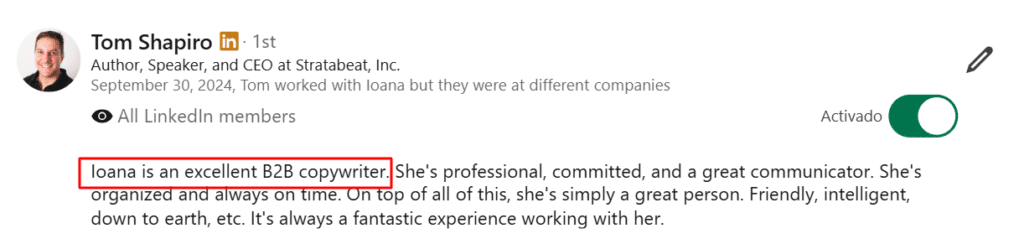
1. Introduce the person who’s getting recommended.
Start with their first name and role.
E.g., “Carrie has been an incredible operations consultant for our team.”
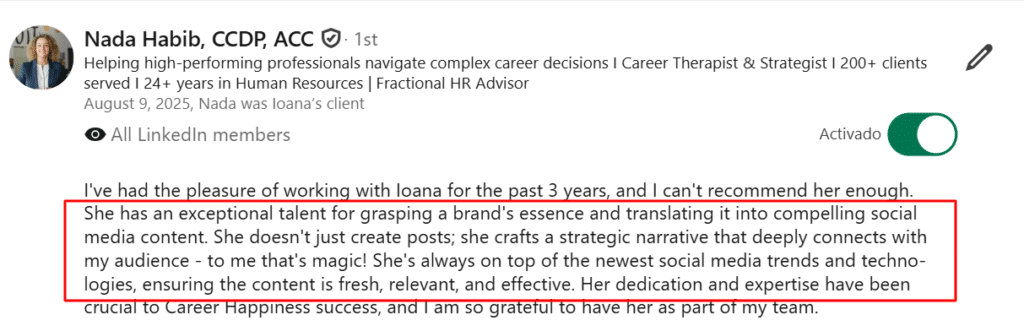
2. Explain how they helped.
Make sure to avoid vague praise. Mention the specific work or problem they solved.
“She helped us build a new operations framework and documented processes across the business.”
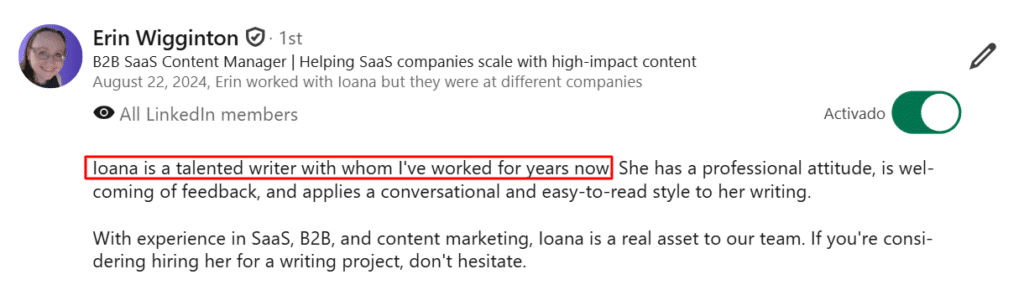
3. Add a timeframe.
Share how long it took to see results or how long you’ve worked together.
For example:
4. Explain the impact.
What changed or happened because of their work? (This is the most important part.)
“Now, our team communicates more clearly, projects get done faster, and everyone knows who’s responsible for what.”
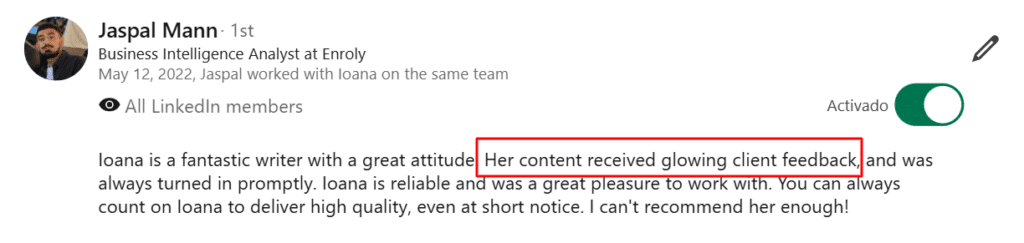
5. End with a recommendation.
Share why someone should hire them. List a specific problem they fix or the solution they provide. Mention that they’re the go-to person for this.
“If you’re looking for someone to untangle messy processes and build systems that stick, Carrie is the person to call.”
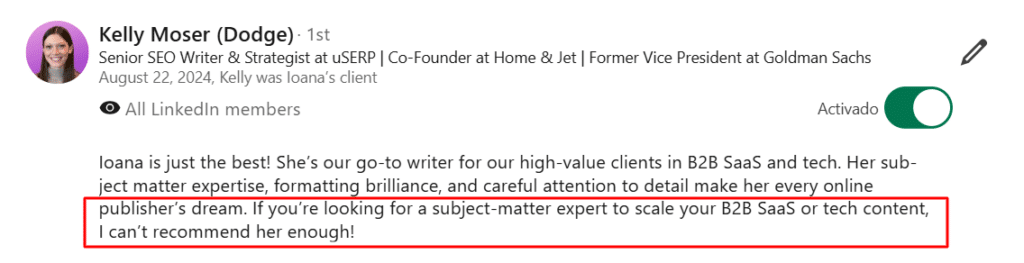
Once you’ve written the testimonial using these five parts, step away from it for a while.
Then come back with fresh eyes and edit your testimonial.
As you edit, remove anything that doesn’t add proof. Replace generic praise with specific examples, cut repeated ideas, and read it out loud to make sure it sounds like something you’d actually say.
When you’re reading it out loud, imagine you’re chatting with a colleague at lunch. Don’t write every “um” and “oh!” you’d naturally utter. But if it feels stiff or overly polished, simplify it.
If you’re drafting a testimonial on a client’s behalf, send them the edited version before publishing it. Ask them to check the timeline, results, and description of your work together. Allow them to change anything that doesn’t reflect their experience. Only publish the version they’ve reviewed and approved.
Here’s how the fictional Carrie example comes together as a complete testimonial:
“Carrie helped us create a new operations framework that completely changed how our team works. Over the last six months, we’ve streamlined internal collaboration, improved client communication, and cut project delays.
If you’re looking for an operations expert who can bring order to growing teams, you want Carrie looking at your processes.”
Notice what’s missing: generic compliments like “Carrie is amazing” or “I’d definitely recommend her,” along with vague statements like “We needed an operations consultant. Carrie was great.” Every sentence gives future clients another reason to trust her.
My best advice is to make it as easy as possible to provide a testimonial. A clear content workflow can help you organize testimonial requests and approvals.
People are busy. If a client says they’re happy to provide a testimonial but doesn’t know what to write, offer to draft one for them based on your work together. Let them know they can edit anything they’d like before approving it.
Experiment with these templates.
Hi [Name],
I really enjoyed working with you on this project. If you have a few minutes, would you be willing to write a short testimonial about your experience? Even a few sentences about what we worked on and the results would mean a lot.
If you’d prefer, I can also put together a first draft based on the project. You can make as many changes as you like before I publish it.
Talk soon!
Hi [Name],
We’ve been working together for a while now, and I’d love to add a testimonial to my website and socials to showcase the work we’ve done.
Would you mind sharing a few thoughts about your experience?
If it helps, I’m also happy to draft something based on our work together. You can edit, change, or remove anything before I use it.
Let me know what you think!
Thanks so much for saying that, [Name] — it really made my day.
Actually … would you mind if I used that feedback as a testimonial? If you’d rather write something more detailed, I’d really appreciate that, too.
Or would you like me to turn it into a testimonial for you to review first? You can edit, change, or remove anything before I use it, of course!
Pleeease don’t hide your best testimonials on a page nobody visits. Put them where people decide whether to trust you, buy from you, or get in touch.
Here are some of the best places to showcase client testimonials.
On your website, testimonials can provide social proof on landing pages and other places where visitors are considering a purchase.
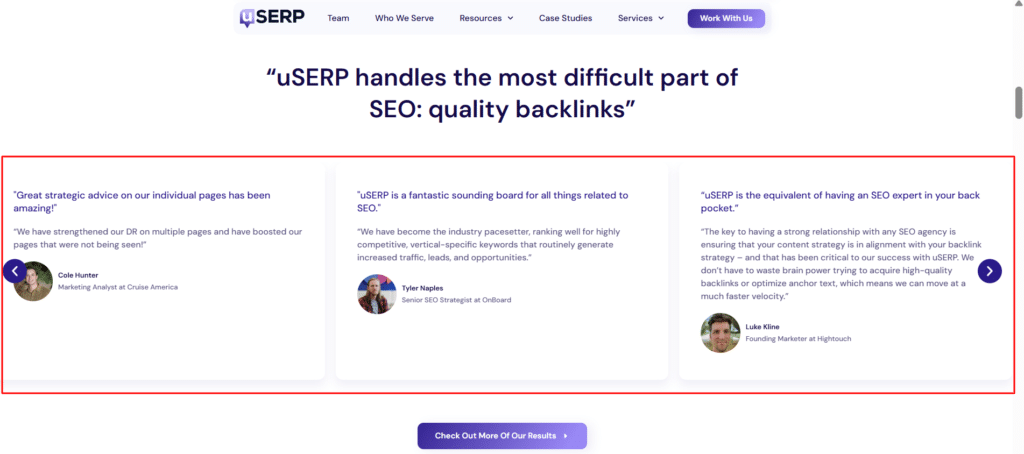
Place testimonials on your:
You can also weave customer stories into broader website content instead of limiting them to a dedicated testimonials page.
In your marketing campaigns
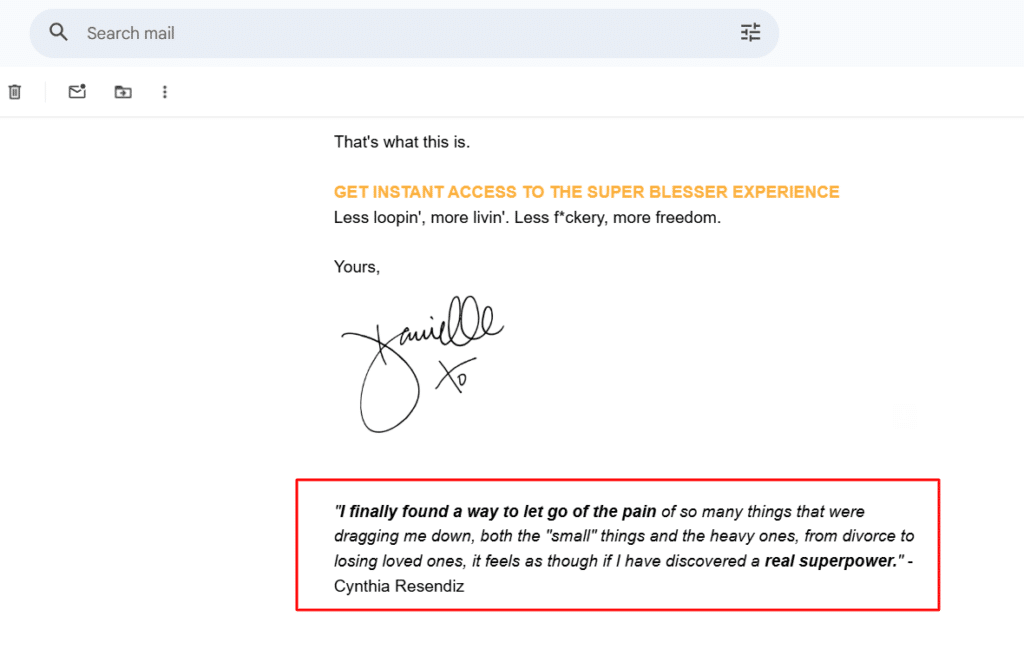
(Image provided by Ioana)
Publish testimonials across:
In your sales materials
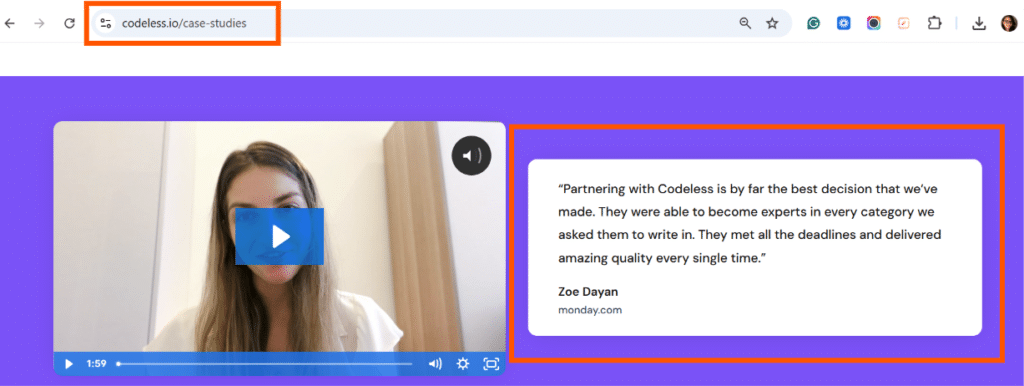
Codeless also features client testimonials within its case studies, as shown below.
Add testimonials to your:
On third-party platforms
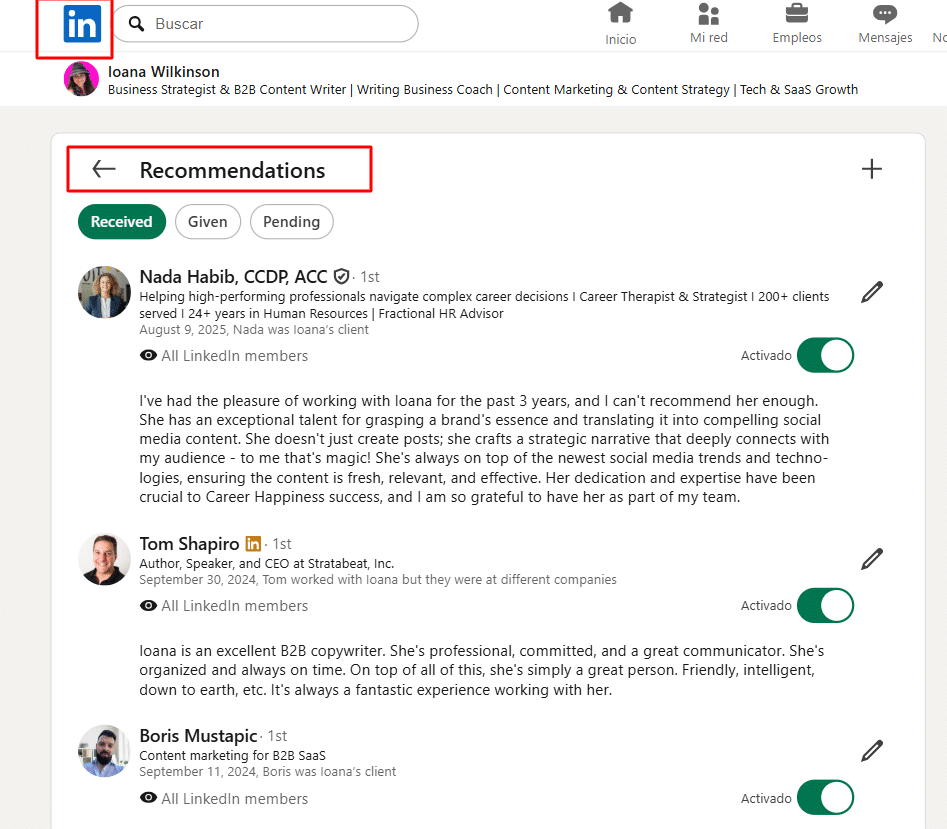
Request testimonials for your:
Vague claims and exaggerated praise can make testimonials seem insincere.
Avoid these mistakes when writing your testimonials:
AI-generated drafts can sound overly polished, repeat buzzwords, and make broad claims that don’t reflect a client’s real experience.
Use AI to brainstorm if you want. But make sure the final testimonial sounds like something a real person would say.
A testimonial isn’t an advertisement.
Focus on the customer’s experience:
❌ “Carrie offers exceptional operational consulting services.”
✅ “Carrie helped us organize our operations so projects stopped falling through the cracks.”
Readers want to know what it was like to work with someone, not how they’d describe themselves.
Don’t exaggerate results or invent details to make the testimonial sound more impressive.
The FTC has also warned businesses that fake or false customer testimonials can lead to enforcement action.
If you mention doubling revenue, saving 20 hours a week, or landing 100 new clients, make sure that’s true, and you have the proof to back it up.
Words like “best, perfect, unbelievable, and life-changing” don’t mean much on their own.
Instead of saying “so and so is amazing,” explain why.
A testimonial doesn’t need your entire working relationship.
Include the problem, action, result, and recommendation. If a sentence doesn’t add anything new, scrap it.
“Tina is really good at what she does” won’t cut it.
Good at what?
Tell readers what Tina actually did and why it mattered.
If you remember one thing about writing testimonials, let it be this: Share the real experience and focus on details that help future clients understand what to expect.
Use the email templates and framework above to gather client feedback, draft your testimonials, and get approval before publishing.
Once clients approve their testimonials, place them on the website pages where potential customers make decisions. If you prepare that website content in Google Docs, Wordable can export it to WordPress, Medium, or HubSpot without requiring you to recreate the formatting manually.
Yes. Many clients are happy to provide a testimonial but don’t have the time to write one themselves. Draft a testimonial based on your work together, then let them review, edit, and approve it before you publish it.
If you can back them up, absolutely. Specific results make testimonials more credible than generic praise. Just don’t exaggerate or include claims you can’t verify.
Yes, but only with their approval. It’s fine to fix spelling, grammar, or formatting, but avoid changing the meaning or adding claims they didn’t make. (You can expand the testimonial a bit if needed, with their go-ahead.)
If possible, yes. Display their full name, job title, company, and a photo underneath or beside the testimonial if they permit you.
AI can help you organize ideas or polish wording. But the client should always provide the experience, opinions, and approval. A testimonial should reflect a real person’s voice.
Quality matters more than quantity. Start with a few detailed, specific testimonials rather than many short comments that all say the same thing.