


Need to create a content style guide your team will actually use this time? 🙃
This guide is here to help. I’ve read so many style guides by now that I could write them in my sleep.
Below, you’ll find a content style guide template you can copy into Google Docs and customize. In just a few edits, you’ll have a content style guide ready for your team. 💪
Let’s take a look!
Highlights
I’ve looked over hundreds of content style guides. (Yes, really.)
Here’s what your style guide should include:
• Company background, mission, vision, and value proposition
• Rules on punctuation, spelling, and grammar
• Examples of top-performing content assets
• Product and feature naming conventions
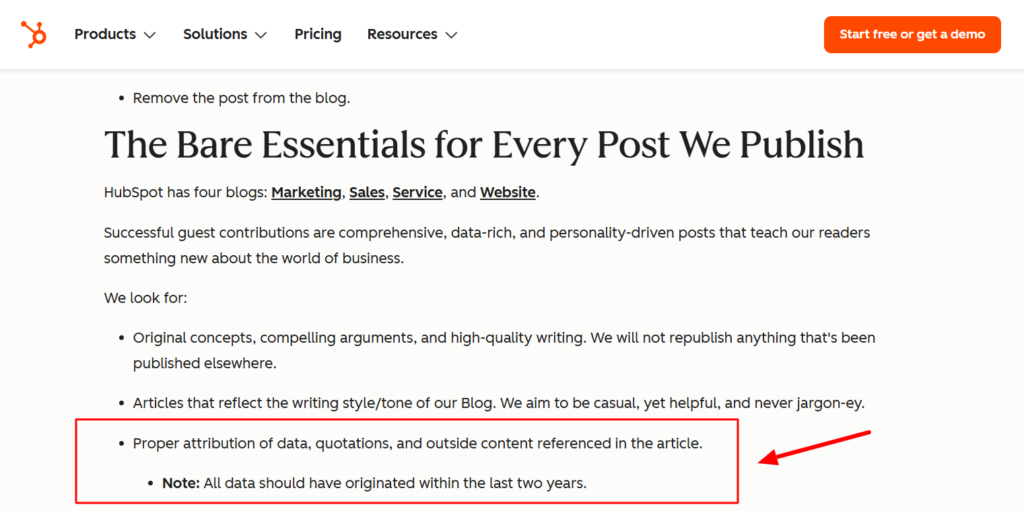
• Research and sourcing requirements
• Rules on images and multimedia
• Internal linking requirements
• Rules on numbers and symbols
• A target audience overview
• Writing style guidelines
• Company competitor list
• Brand voice guidelines
• Key brand terminology
• Formatting standards
• AI usage guidelines
• SEO requirements
• Brand assets
More on what this looks like in a bit. 💃🏻
Creating a content style guide is one thing. Getting people to actually use it is another.
Over the years, I’ve noticed that teams don’t ignore their content style guide because they don’t care. They ignore it because it’s difficult to apply in the middle of a busy workday. (Ask your team about this, and you may hear the same thing.)
Senior Content Designer, María Alejandra, recently wrote:
“I’ve built several content style guides throughout my career. Beautiful. Comprehensive. 47 pages of tone guidelines, voice principles, grammar rules, examples. Nobody used any of them. And when I say nobody, I mean, nobody.”
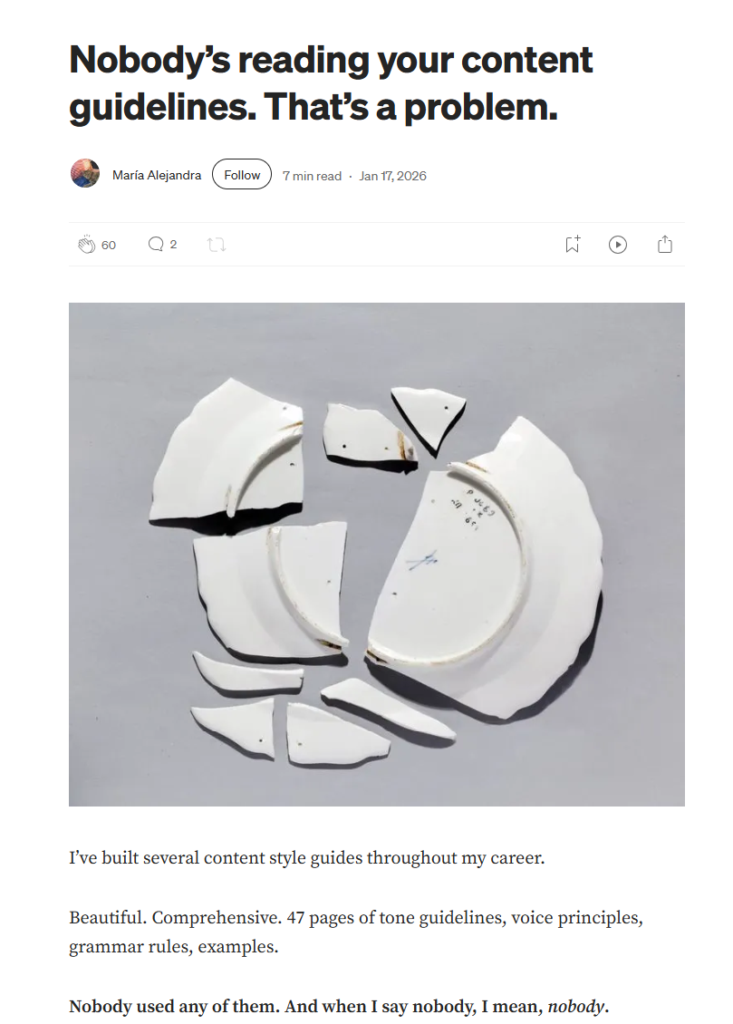
If your style guide says things like “write conversationally” or “keep the tone professional,” people will interpret those instructions differently.
One writer might sound friendly and capture your brand personality. Another might sound overly formal. You want to remove that guesswork by showing examples of what to do and what to avoid.
Many companies create a style guide, share it once, and then forget about it.
Six months later, nobody knows where the document lives. New hires have never seen it. And freelancers don’t even know it exists.
Your content style guide should have a permanent home that everyone can access. Better yet, include a link to it in every content brief, onboarding document, and project management template.
When documentation is difficult to navigate, people stop using it and rely on memory instead.
Focus on sharing rules that have the biggest impact on content quality and brand consistency.
Nobody expects a style guide to be entertaining, but it should be easy to read.
Use short explanations, clear examples, and screenshots to make information easier to absorb and remember. I also like using emojis. Clearly. 🙊
Remember to include a link to your style guide in EVERY content brief you assign. Stress to writers that it’s a living document, so they need to keep an eye out for updates. (I’ve noted this in the template.)
Below, I’ve included a content style guide template you can copy and paste into a Google Doc and fill in.
Feel free to change up the wording, add to it, or scrap sections you don’t need.
One last thing before I show you the template …
Try to envision your team using it. Picture content creators and editors sitting at their desks with a cup of coffee and your style guide on screen. What do you want them to focus on while writing? What’s MOST important to you? Get to the point.
Here’s a visual to make that scenario concrete. 😂👇
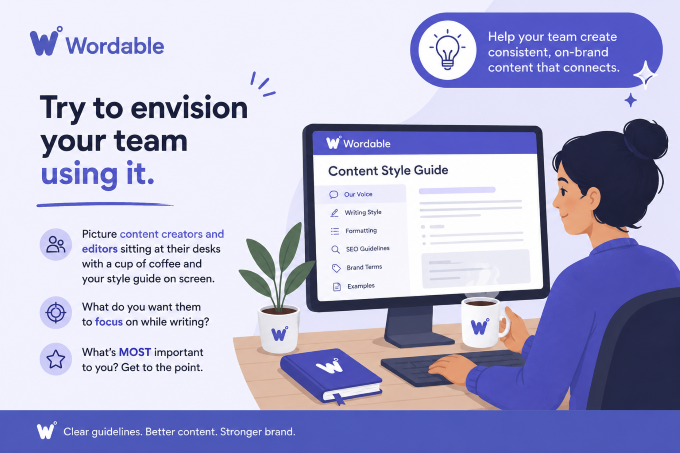
(Image by Ioana)
K, now let me get to the point. 👇
Hi team, 😄
Thanks for taking the time to read through our style guide. Please review this doc before writing or editing to make sure content stays on brand. (This is a living doc and we update it often!)
If you have any questions, feel free to reach out to ____________ or ____________.
Our history: [Briefly explain how and why your company was founded.]
Our mission: [Summarize the purpose that drives your company.]
Our vision: [Describe the long-term impact you want your company to have on customers, your industry, or the world.]
Our value proposition: [Explain the unique value you provide, who you provide it for, and what problem it solves.] This is central to our brand messaging, so reflect it where relevant.
Audience demographics or firmographics: [List key audience characteristics, like age, job title, industry, company size, location, or experience level.]
Audience pain points: [Summarize the biggest challenges, frustrations, or obstacles your audience wants to solve.]
Include links or screenshots to audience personas if you have them. These help writers understand your audience and the solutions they need.
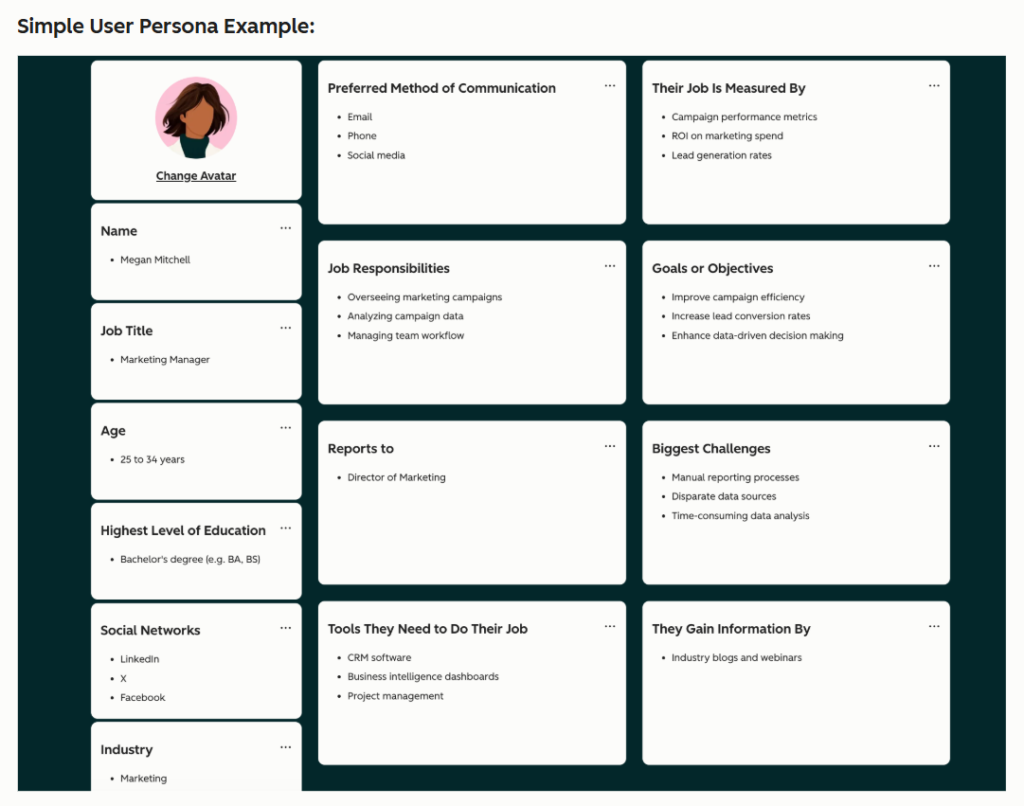
Audience goals: [Describe what your audience is trying to achieve and the outcomes they care most about.]
Primary logo: [Insert logo file or link to logo files. Plus notes on logo usage.]
Secondary logo variations: [Insert alternate logos, icon-only versions, light/dark versions, etc.]
Primary brand colors: [List color names and HEX codes.]
Secondary brand colors: [List color names and HEX codes.]
Brand fonts: [List approved fonts and typography and when to use them.]
Brand asset folder: [Insert link to your brand kit, design files, or asset library.]
Our tone of voice is: [List three to five adjectives, such as conversational, knowledgeable, friendly, or approachable.]
Here are some examples that showcase our ideal brand voice:
✅Yes: [Good ToV example sentence.]
❌No: [Poor ToV example sentence.]
✅Yes: [Good ToV example sentence.]
❌No: [Poor ToV example sentence.]
✅Yes: [Good ToV example sentence.]
❌No: [Poor ToV example sentence.]
And here’s a list of words to avoid:
Please follow these writing style guidelines to maintain consistency across channels and website content:
Our competitors include:
Please avoid linking to or mentioning our competitors unless you’re writing a comparison or competitor piece.
Here are our most profitable blogs and content assets and why they hit the mark:
<Include screenshots of different types of content with annotations to your favorite parts.>
Here’s how we refer to certain brand/company details:
Examples:
Here’s how we refer to our products and features.
We say:
✅[Product/feature naming convention]
✅[Product/feature naming convention]
✅[Product/feature naming convention]
We don’t say:
❌ [What not to say]
❌ [What not to say]
❌ [What not to say]
This is especially important to include if your team writes SaaS marketing content.
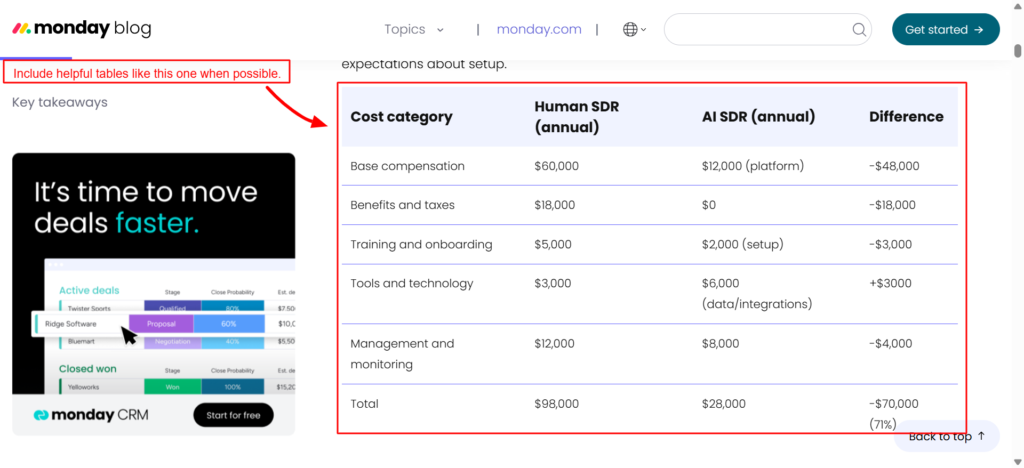
Our formatting requirements include:
Examples:
Show screenshots if you want a certain look, like this:
Please follow these internal linking requirements:
Examples:
Please follow these SEO requirements for each piece:
Heading structure expectations: [E.g., “Use one H1 and descriptive H2s. Use H3s when needed to organize information beneath an H2.”]
Primary keyword placement: [E.g., “Include the primary keyword in the title, introduction, at least one H2, meta title, meta description, and URL slug when natural.”]
Meta title format: [E.g., “Keep meta titles under 60 characters and include the primary keyword near the beginning when possible.”]
Meta description format: [E.g., “Keep meta descriptions under 160 characters. Include the primary keyword naturally. Write in an engaging way to sell the content and encourage clicks.”]
URL slug rules: [E.g., “Keep URLs short, descriptive, and lowercase. Include the primary keyword. Remove unnecessary words and dates.”]
Here are our rules and guidelines around using AI tools:
[For example, “Writers can use AI tools for outlining and first drafts only. All final drafts must sound human and on-brand.” Or, “Please only use AI tools for SEO optimization and content editing.”]
Quick note from Ioana: 32% of desk workers have already experimented with AI tools. And 50% of that group use AI at work at least weekly, according to research from Slack. So it’s worth mentioning this in your style guide!

Before rolling out the guide, trim each section to the minimum set of instructions a writer needs to act. The goal is a document people can consult during production, not one they have to study beforehand.
Here’s a super quick example of what short and sweet looks like:
Our history:
“We started in 2020 when cyberattacks were becoming a growing threat for enterprises around the world.”
See? Keep each section to one sentence, or two at most.
Okay, I’ve given you the best I’ve got with this guide.
Now it’s your turn to take this template, edit it, and implement it across your content team. (Or across different departments if you run an enterprise.)
Remember to update the guide as your requirements and brand voice evolve, and notify your team whenever the rules change.
Once the guide is in place, Wordable can help your team preserve those formatting standards during publication. It lets you format and upload completed Google Docs to WordPress in one click.
Your content style guide should be as short as possible, while still covering the information your team needs.
There is no fixed page count. Keep the core guide only as long as necessary to cover the rules your team uses regularly.
If your style guide feels overwhelming, look for opportunities to simplify instructions. Or remove rules that rarely come up during the writing process. Make sure your style guide stays consistent across micro teams so your brand voice remains steady.
Typically, a content manager, editor, marketing manager, or brand strategist creates the first version.
But the best style guides include input from writers, editors, SEO specialists, and anyone else involved in the content creation process.
Review your content style guide at least once or twice per year.
You should also update it whenever your brand voice, products, SEO requirements, target audience, or content processes change.
Absolutely. In fact, freelancers often benefit from it the most.
Sharing your content style guide during onboarding can reduce revisions, speed up content production, and help external contributors create cohesive content that feels consistent with your brand.
A brand style guide helps you understand a company’s visual style and design standards.
A content style guide focuses on how a company communicates through written content. It includes a brand’s voice and tone guidelines, as well as its preferred writing style and formatting. It also includes SEO requirements. It might also include a short section on visual branding.
Both of these are very important for supporting remote work communication.
Trying to include everything.
A style guide should be easy to skim and apply during the writing process. If important rules are buried beneath pages of unnecessary information, your team is less likely to use the document consistently.